Agafay or the Sahara: Which Desert You Want, and When
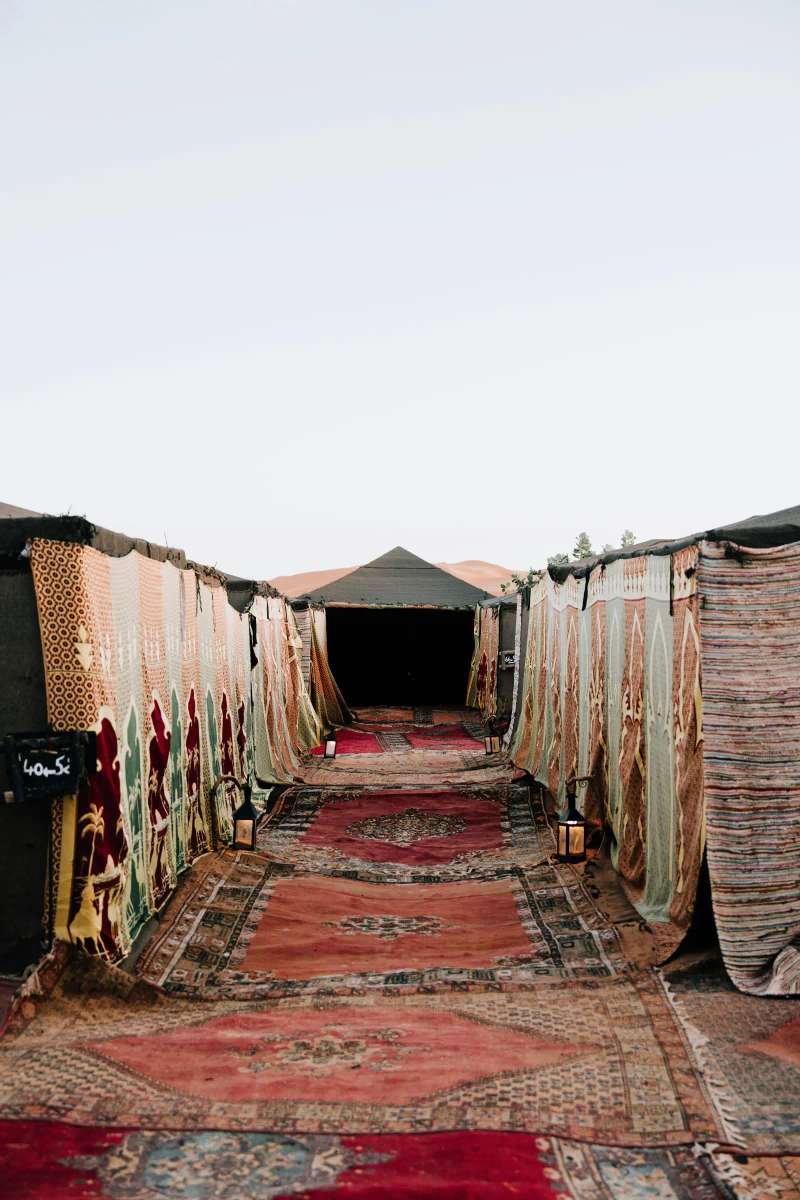
Agafay is not the Sahara, and the Sahara is not a day trip. Almost every disappointment people report about the desert from Marrakech comes from one of those two sentences not having been said before they booked.
Agafay is a stone and clay plateau about 45 min from the city — bare rounded hills, dry riverbeds, the High Atlas standing behind it. From most ridges you can walk for twenty minutes and see nobody, and the last hour of light is what people photograph. It has no dunes and never has. The Sahara proper, the erg with the sand mountains, is far enough south that reaching it and spending any real time there needs two nights at the very least.
The confusion is commercial rather than geographic. Camps in Agafay are sold with the word desert doing two jobs at once, photographed from angles that keep the road out of the frame, and priced against the idea of the Sahara when what they are really selling is the short transfer. Very little of it is an outright lie. The word is simply allowed to carry more than it should.
Both are worth doing. They are not alternatives, though, and they are routinely sold as if they were one.
The Two Deserts
Stone, Clay and Why There Are No Dunes
A rocky desert, or hamada — the most common desert surface on earth, and the one nobody photographs. Pale stone, hard clay, low hills folding into each other, dry beds cutting through. At midday it is flat and unremarkable. In the last hour of light it becomes one of the most striking landscapes near Marrakech, with the ridges going gold and the Atlas turning to silhouette behind.
There is a reason it has no dunes, and it is not an accident of where the photographs were taken. Dunes need two things this ground does not have: a standing supply of loose sand, and a wind that keeps pushing it the same way for long enough to build crests. Agafay is the opposite — an eroded shelf of clay and gravel between the Kik plateau and the Lalla Takerkoust reservoir, carved by winter run-off rather than piled up by wind. What that produces is ridges and gullies.
The evening is the whole reason to go, and it is why our own Agafay experience is built as one: 4h on site, with the arrival set by sunset and the heat already off the stone.
Sand is the one thing it does not have. If you have seen a photograph of an Agafay camp with golden dunes rolling away behind the tents, it was taken somewhere else or the sand was brought in and spread around the terrace. This is worth saying plainly, because the listings themselves rarely do.
Set that expectation down, though, and what remains is specific and good. The ground is hard, so you walk on it in ordinary shoes, which means grandparents and small children get out of the car and go somewhere instead of watching other people go somewhere. The Atlas is close enough to read individual valleys on a clear evening and holds snow on the high ridge into spring. And because the plateau is bare, the horizon is uninterrupted in most directions, which is the part people are really after when they say desert.
It is worth knowing the limit before you stand in it. Agafay is not endless. From several ridges you can see the reservoir, the road, and the lights of the village beyond it. Which part of the plateau you are taken to decides how much of that is in your field of view.
A Night in Agafay, Hour by Hour
The whole thing turns on when you leave. We build the evening backwards from sunset: 45 min on the road, 4h on site, and an arrival roughly two hours before the sun goes.
The drive out is short and unusually abrupt. Marrakech does not taper — past the last of the palmeraie the ground turns grey and stops being farmed. The final stretch is graded piste, and it is the first real measure of how far in a camp sits: a minute of gravel means the near edge, a quarter of an hour means you are somewhere else entirely.
The first hour on site is the one most people waste sitting down. The sun is still high, the light is flat, and this is the hour to be moving instead — out along a ridge on foot, on a camel at walking pace, or on the tracks if you have taken the quad ride, which runs 2h30 and ends at a bivouac out in the hills.
Then the light does its work, and it does it fast. The window is perhaps twenty minutes, when the ridges hold colour and the Atlas goes flat black behind them. Be on your feet somewhere with distance in front of you when it happens. Almost every regret we have heard about an Agafay evening is a version of having been sat down too early.
Dinner should come after the light. Plenty of camps serve through it, which gets the order backwards. Musicians belong at a distance; a band at your table removes the one thing you drove out for. Prayer should not have to be negotiated on arrival either — Prayer stop included is a stated attribute on 16 of our experiences, this evening among them.
Then the cold arrives, and it is the part nobody is warned about. Stone gives up its heat quickly, and a plateau that was too hot at six is cold by nine in every month of the year. The drive back is the same road in the dark, with piste at one end of it. That is an argument for a driver who has done it before.
What an Agafay Evening Asks of You
A layer more than the forecast suggests. Stone loses its heat the moment the sun is off it, and the terrace is open on every side.
Shoes with a sole. The ground is gravel and shale, and the ridges are worth walking.
Arrive two hours early. A camp that seats you at sunset has sold you dinner with a view.
Something over the shoulders, and nothing white. Wind lifts fine dust off the tracks and it settles on everything.
Why There Is No One-Day Sahara
The dune fields — Erg Chebbi in the east, Erg Chigaga in the south — are not near Marrakech in any useful sense. Getting to either means crossing the Atlas and continuing for hours beyond it.
The clearest way to feel that distance is to measure it against the longest day we do sell. A crossing of the Tizi n'Tichka to Aït Ben Haddou is 3h40 each way and 7h20 in the car altogether, and it is already a day we ask people to plan nothing else around. The nearest true erg is several hours further on from where that day turns around.
What that means practically is simple. A trip that leaves Marrakech in the morning and returns the same night can either reach the desert edge and turn straight round, or it cannot reach the desert at all. Neither version gives you time in the dunes at the two hours of the day when they are worth being in.
There is a third version, and it is the one that sells: the word desert is quietly moved. An itinerary that never names the erg it is going to, or that offers "the desert" as an afternoon add-on, is taking you either to Agafay under a borrowed name or to a stone plain somewhere short of the real thing. Zagora is the middle case and worth naming — a genuine pre-Saharan town with a modest patch of dunes at Tinfou, reachable in a long day's drive. It is a smaller thing than the word Sahara implies, and it is sold under that word constantly.
So the options are these. Two nights gets you south of the Atlas with a real night in the sand and enough margin for the drive not to consume everything. Three nights is the version people enjoy, because the driving splits across days instead of stacking into two brutal ones. One day is not an option, and the operators selling it know that.
We do not offer a Sahara day trip. There is no version of it we could run that would not end in someone feeling misled, and the closest we go is a long crossing over the Tichka pass — a day about the road and the ksar at the end of it.
What the Real Sahara Is
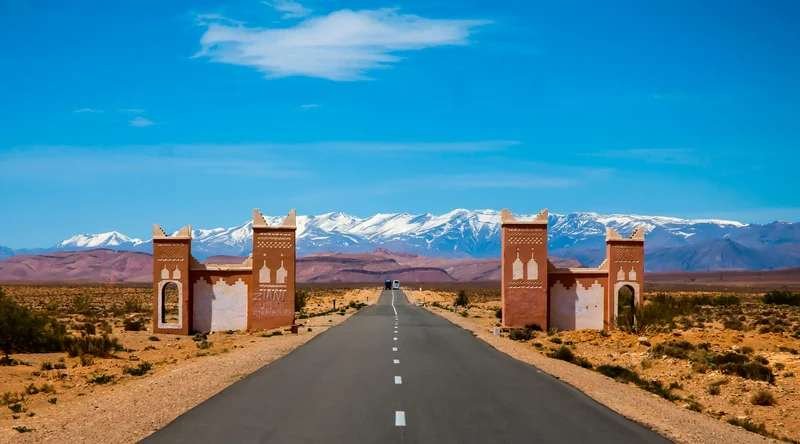
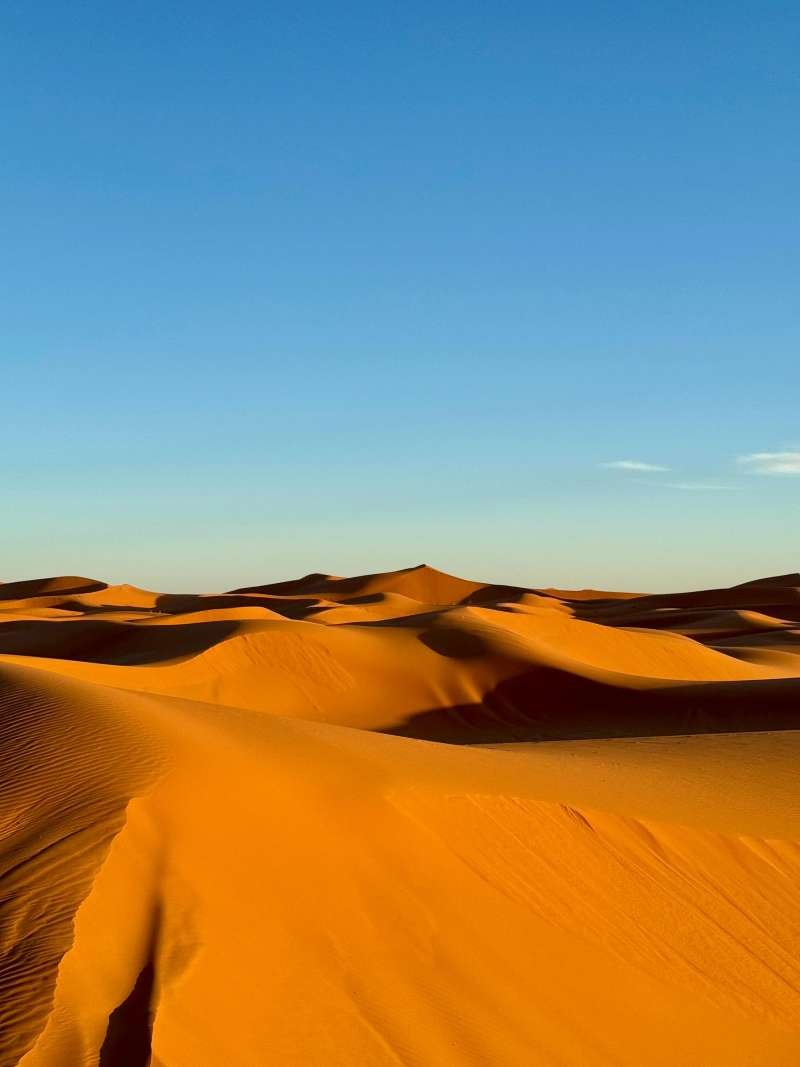
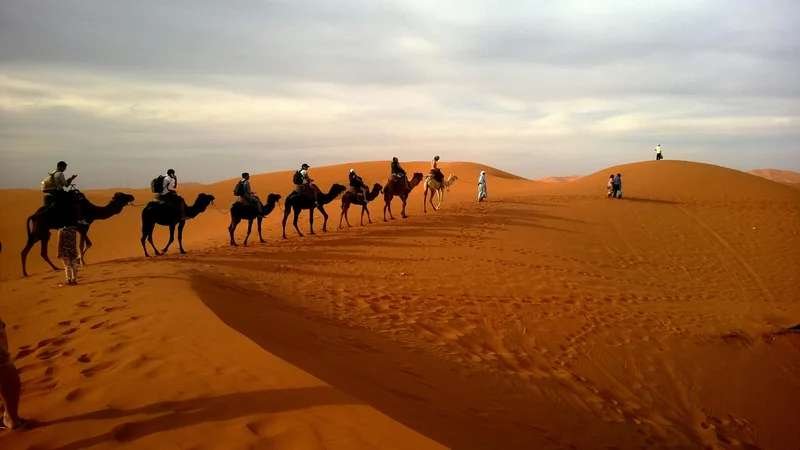
An erg is a sand sea: wind-built dunes with a supply of sand behind them, deep enough that the ground underneath stops mattering. Morocco has two that a traveller can reasonably reach: Erg Chebbi and Erg Chigaga.
Erg Chebbi, above Merzouga in the east, is the accessible one. Tarmac runs to within sight of the sand, camps sit a short ride in by 4x4 or camel, and the high ridge stands well over a hundred metres above the plain — enough that climbing it in soft sand is real work and the view from the top is why people go quiet at sunrise. It is also the busier one: many camps, quad bikes on the fringe by day, a strip of hotels along the edge.
Erg Chigaga, beyond M'Hamid in the south, is the remote one. There is no tarmac to it. The last stretch is a long run on piste, and that barrier is exactly what keeps the camp count low and the horizon clean. If emptiness is what you are after, it is the one, and you pay for it in road hours at both ends.
What you are buying in either place is a night. The dunes at midday are hot and monotone, and no photograph is taken then. What justifies the journey is the hour before dark, the hours after it, and the hour after first light — plus a silence at two in the morning with no traffic, no aircraft and no generator anywhere in it. That particular absence is not available within reach of Marrakech, Agafay included.
The word luxury covers a very wide range out there. At one end it means a bathroom inside the tent, hot water in the morning, a real mattress and a cook. At the other it means the same canvas photographed better. The questions that separate them are about plumbing, generators, and how many tents share the hollow.
Two Nights or Three: What the Driving Involves
These itineraries are sold in nights and experienced in road hours, so it is worth converting them before you agree to one.
The two-night Chebbi loop puts its longest drive first. Day one crosses the Tichka, stops at Aït Ben Haddou and continues through Ouarzazate and down one of the valleys — longer in the car than the 7h20 our own Tichka day spends, and unlike that day it does not end at home. Day two is the kind one: a gorge in the morning, the palm belt after it, camp before sunset. Day three puts the entire return between breakfast and dark, and it is the day people describe afterwards in a flat voice.
The three-night version changes one thing and fixes most of them. The return is split — a night at Skoura, at Ouarzazate or in the Dadès — so that no single day runs longer than a day you would already have accepted as long. It costs one more night of accommodation and takes the full-return day out of the itinerary.
Chigaga runs on a different axis. The usual approach is down the Draa through Agdz and Zagora to M'Hamid, a full day on tarmac, and then the piste, which is not a road and cannot be hurried. Some itineraries return by Taroudant or over the Test to make a loop of it, which is more interesting and longer still.
Whichever version you take, the return leg is where plans break. Nobody underestimates the drive out; anticipation carries it. The drive home is the same road with none of that, usually with a checkout time imposed at one end and something important at the other. If you fly out of Marrakech in the morning, do not plan to arrive from the desert the night before.
There are people this does not suit, and saying so is more useful than selling it. Children under about six take very little from a dune field and a great deal of the car. A back that objects to long journeys will object to this one. And a trip with only a few full days in Morocco cannot absorb it without hollowing out everything else — which is precisely the case where Agafay stops being a compromise and becomes the right answer.
Questions That Separate Sahara Itineraries
Which erg, by name? An itinerary that says only the desert is not going to one.
How many hours in the car on the longest single day? An average hides the day that ruins the trip.
Where does the camp sit relative to the sand? A camp on the fringe with a view of dunes is not a camp in them.
Is the vehicle yours? Shared transport runs to the slowest passenger and stops where commission is paid.
What happens on the last day? A return that lands after dark before an early flight is a plan with no margin in it.
What Has Changed in Agafay
The landscape has not changed. The occupancy has, quickly.
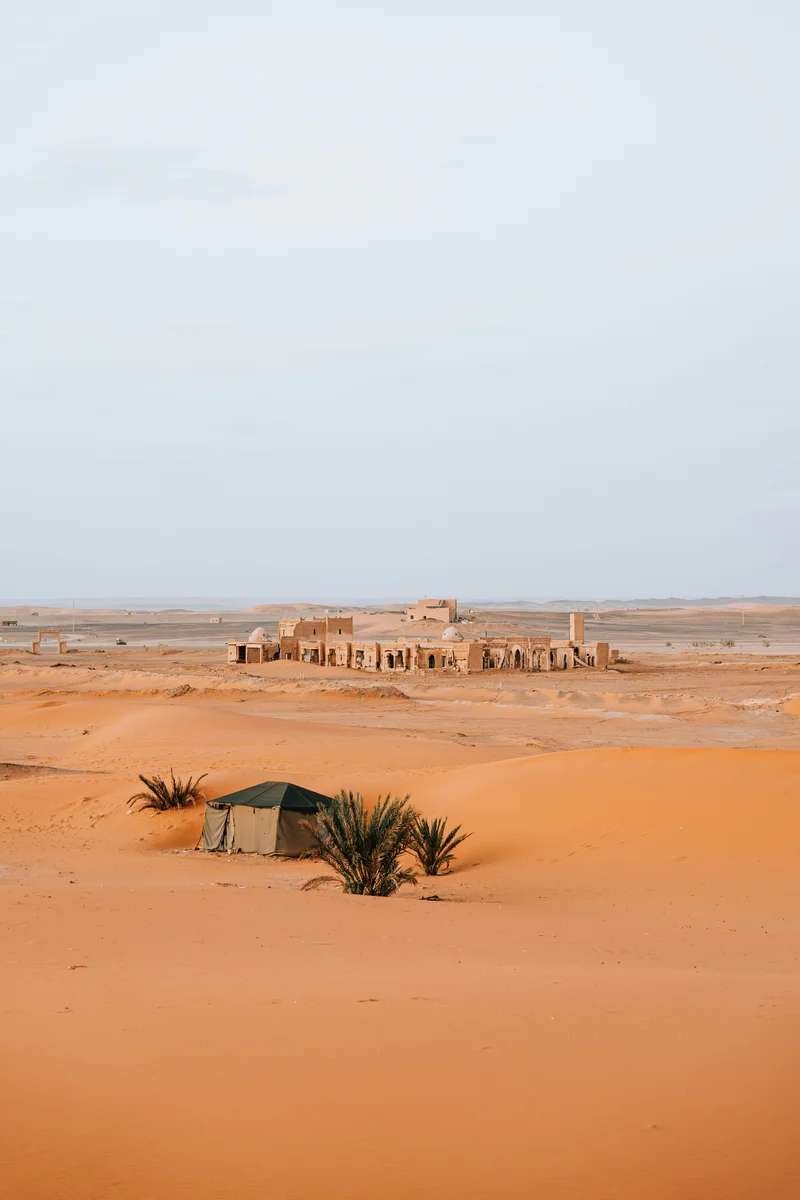
A few years ago Agafay held a handful of camps. It now holds dozens, and they are not spread evenly — they cluster along the accessible near edge closest to the road out of Marrakech, because that is the cheapest ground to build on and the shortest transfer to sell. On a busy Saturday that section carries music from several directions at once, headlights crossing the tracks, and a general atmosphere closer to a festival site than an empty place.
This is the substance behind the growing complaint about Agafay, and it is worth separating from the landscape itself. The quiet is still there. It is simply further in, away from the cluster, on ground that costs more to reach and therefore appears less often in the cheapest listings.
Which makes the practical question not "is Agafay still good" but "which part of Agafay, and at what hour". Sunset on the far side with nothing audible is a different evening from sunset three hundred metres from four other camps, and the two are sold under the same name.
So the useful skill is reading a listing, and listings are written to be unreadable on precisely this point. A few things give a site away reliably.
Distance is quoted from the wrong end. "Ten minutes from the road" is the number that matters and is almost never printed; the transfer from Marrakech tells you nothing, because the near edge and the far interior are much the same distance from the city and everything that separates them happens in the last few kilometres. Ask for a pin on a map. A camp confident about where it sits will send one within the hour.
Capacity is the second tell, and the figure a site quotes is its maximum. A site advertising a hundred and fifty covers is not a quiet place on the night it has them, whatever the photograph of the empty terrace suggests, so ask how many tents, how many tables and how many other parties are booked on your date.
The listing's own photographs answer more than the copy does, if you read the skyline instead of the styling. A wide shot taken from the ground upward will not show you what stands behind the camera. Tents on the ridge behind the shot, a road in the middle distance, floodlights on poles: all of that is in the frame and none of it is in the description.
Then two separate questions about noise. Amplified music is one, and every camp will call its own traditional — ask instead until what hour, and whether neighbouring camps are audible, because sound carries absurdly far over bare stone. The generator is the other. At many sites it runs all night, and how far it sits from the tents is worth asking before you book.
What to Ask Before Booking Any Agafay Evening
How far in is the camp? Near-edge sites are cheaper and busier. The distinction is never in the listing.
How many other camps are within sight or earshot? A camp can be private and still sit in the middle of a cluster.
Is there music, and until when? Several camps run amplified entertainment, which carries a long way over open ground.
What time does it start? An Agafay evening that begins at sunset has missed the hour that made it worth coming for.
Seasons and Temperature in Both Deserts
Agafay works in every month of the year, though not at every hour of them.
March to May and late September to November are straightforwardly good: warm afternoons, long light, an evening that stays comfortable through dinner. In July and August the plateau at midday is punishing and completely shadeless, which is why the evening exists; by the time an evening on site begins, the worst of the heat has gone. From December to February the light is at its best and the cold comes with it: snow on the ridge behind, the clearest sky of the year, and a coat, not a jacket. Spring wind is the one variable that can take the evening away from you, because blown dust flattens the light for hours at a time. Ramadan changes the shape of the evening without closing it: nothing is served until the maghrib call, so the meal lands with the last of the light and the camp stays up long after it.
The Sahara has a narrower window, and pretending otherwise is how people end up in an oven. October to April is the season. From May to September the middle of the day in the erg cannot be used at all, which removes half of what you drove for. In December and January the nights at Chebbi fall close to freezing, so ask how many blankets come with the tent.
The mountain in between has a season of its own, and it is the part of a Sahara plan most likely to fail. The Tichka carries snow in winter and closes occasionally at short notice, and roadworks below it make delays routine. A three-night itinerary with a spare afternoon absorbs that. A two-night itinerary with a flight at the end of it does not.
Which Month, Which Desert
March to May, late September to November. The only window in which the erg and Agafay are equally comfortable.
June to August. Agafay in the evening only. The Sahara is best left alone, because the middle of the day cannot be used.
December to February. The clearest light of the year on the plateau and the coldest nights in the erg. Bring far more warmth than the afternoon suggests.
Ramadan. The camp waits for the maghrib call, and the evening runs long past it.
Choosing Between Them
Choose Agafay when what you have is an evening. When you want an empty landscape, a good table and a sky full of stars without losing two days to a car. When you are travelling with people for whom a long drive is the thing that ruins a day. And when you can go on a weekday, or far enough in, to get the quiet version.
Choose the Sahara when you have three days and the real thing is what you want: dune fields running to the horizon, silence with nothing mechanical in it, and a night sky with no town glow on any edge. It is a different order of experience from Agafay, and it costs days you have to have in the first place.
Choose neither if you have one day and were only going because a desert seemed compulsory. A day in the High Atlas or on the coast will give you more than a rushed approximation of a desert, and you will not spend it in a car.
That last case deserves a real answer, because the impulse behind it is sound. People want the empty, elemental, non-urban half of Morocco, and they have been told the only door to it is a desert.
There are better doors within a day. The lake at Lalla Takerkoust is 45 min out on the same road as Agafay, with the same mountains behind it and water in front of them. The Ourika valley is 1h10 and green in the months when the plateau is not. Oukaïmeden puts you on high ground with prehistoric rock carvings almost nobody stops for. And if what you want is specifically the south — pre-Saharan colour, packed earth, palm groves, the road going over rather than around — the Tichka crossing to Aït Ben Haddou is the honest one-day version of that instinct. It is 7h20 in the car and it does not pretend to be a desert.
If You Have One Day and Wanted a Desert
Say what you are after. Most people mean emptiness, distance and a clean horizon, not sand specifically, and once that is said out loud the options widen considerably.
Agafay gives you exactly that inside an evening. It is the only empty landscape near the city that also gets you back for the night.
For the south in a day, cross the pass instead. A mountain crossing to a packed-earth ksar is an honest day out. A desert in a day is not.
For green, go up a valley. The Atlas valleys and the lake below them are shorter drives than any of it.
The Practical Version
Go to Agafay for the last two hours of daylight. At noon it is a grey stone plain with no shade anywhere on it.
Ask where the camp sits, and treat vagueness as an answer.
Do not book a Sahara day trip. If someone is selling you one, they are selling either Agafay under a borrowed name or twelve to fourteen hours in a car to reach the pre-Saharan edge at Zagora and come back.
Sequence them properly if you are doing both. Agafay belongs on a first or a last evening, when you are either not yet committed to an early start or no longer facing one. Where it does not belong is the night before a Sahara departure, because those days start early.
And settle the itinerary first. Agafay fits into an evening you already had; the Sahara only works if you have handed it the days.
Our Agafay evening and everything else within reach of the city sit in the catalogue, each with its distance and its hours on site written on it, so you can see what a day costs in driving before you commit to it.
Agafay or the Sahara
Frequently Asked Questions
- Is Agafay a real desert?
Agafay is a real arid landscape, though not a sand desert. It is a stone and clay plateau of bare hills roughly 45 min from Marrakech, with the High Atlas on the horizon. There are no dunes and there never were. Photographs showing golden sand at an Agafay camp were taken somewhere else, or show sand that was trucked in and spread around the tents. Go for an empty landscape close to the city and an hour of very good light at the end of the day.
- Can you visit the Sahara on a day trip from Marrakech?
No, because the nearest true dune fields are seven to nine hours from Marrakech in each direction, and anything sold as a one-day Sahara trip is either Agafay under another name or a punishing drive to the desert edge and straight back.
- How far is Agafay from Marrakech?
About 45 min by road. That is the whole advantage: it is the only empty landscape you can reach, spend 4h in, and be back from the same evening.
- Is Agafay too touristy now?
It has changed a great deal. A handful of camps a few years ago is now dozens, and they cluster along the near edge closest to the road out of Marrakech, because that is the cheapest ground to build on and the shortest transfer to sell. On a Saturday night that section carries music from several directions at once and headlights crossing the tracks. The quiet is still there, further in, on ground that costs more to reach. So the question worth asking is which part of the plateau your camp sits on.
- Which is better, Agafay or the Sahara?
They answer different questions. Agafay is for an evening: a dramatic landscape and a good table without losing days to driving. The Sahara is for three days, and gives you dune fields, silence, and a sky with no town on any horizon.