The Argan Stop: How Commission Works on a Marrakech Day Trip
The argan stop on your day trip is almost always a commission stop. The driver who takes you there is paid a percentage of what you spend — the figure quoted across the Moroccan trade is 20 to 40 percent — and that percentage is already inside the price on the shelf. The oil is frequently genuine. The building may well be a cooperative. What is misleading is the framing: it is presented as part of the itinerary, a cultural stop on the way to somewhere else, when it is a sales appointment that someone was paid to keep.
It is the most common complaint about day trips from Marrakech, and almost nothing written about those day trips addresses it directly. The reason is structural. Most of the pages ranking for "day trip from Marrakech" are sold by operators who take the commission, or by marketplaces whose suppliers do. Explaining the mechanism would cost them money.
The Commission Stop At a Glance
How the Money Moves
The arrangement is simple and rarely written down. A shop on a well-travelled route agrees to pay a percentage of any sale to the driver or guide who brings customers through the door. The driver is often paid modestly for the day itself, sometimes barely above fuel and wear, on the understanding that commission makes up the difference.
Settlement is informal but always tracked: a numbered card handed over at the door, or a running tally at the till that clears each week. Often two people are paid out of one purchase, because the agency that sold you the day holds its own arrangement with the same shop. The driver rarely comes onto the sales floor, so nothing you can see connects him to it.
That structure explains behaviour that otherwise looks strange. It explains why the stop appears where it makes no geographic sense, and why fifteen minutes becomes fifty. It explains the friendly questions on the drive out — what you do, whether you are furnishing a house — which are qualification, and are often phoned ahead. And it explains the mild, persistent disappointment when you buy nothing. You have not been rude. You have cost someone their day's income.
It also explains the price. A shop paying out 20 to 40 percent has to price for it. The identical bottle, the identical rug, the identical tin of saffron, is cheaper where nobody is being paid to deliver you.
The Driver's Side of the Arithmetic
The obvious conclusion — that the driver is on the take — is the wrong one, and acting on it produces a bad day for everybody in the car.
Work backwards from the listing price. A day sold on a marketplace has to undercut every comparable listing to be seen at all, and out of the winning price come the platform's cut, the agency's margin, fuel, the vehicle, its insurance and the tourist-transport licence it must carry. What is left is the driver's day, and it is not a wage. Commission closes the gap between a price low enough to win the listing and an income somebody would get out of bed for.
Then add the calendar. A Marrakech driver's year is two crowded shoulder seasons with long flat stretches between them, and the empty weeks are paid for by the weeks with a purchase in them. Pressure at a stop rises when the road is quiet.
Two things follow. You cannot fix this with generosity, because a tip is discretionary and arrives afterwards while a percentage of a rug is neither. And paying the driver privately to skip the stops backfires: it makes his income depend on you again, and sets him against whoever dispatched him. You have moved the incentive, not removed it.
The person to take this up with is not the driver. It is whoever sold you a day at a price that only works if you shop.
Questions That Reveal the Pay Structure
“Is the driver your employee, or a subcontractor you dispatch?” Both can be perfectly good. The answer tells you who controls the shape of the day.
“Is he paid the same whether we buy anything or not?” This is the question everything else turns on. Anything other than a plain yes is a no.
“Who pays for the fuel and the vehicle today?” If the answer is the driver, and the day rate is thin, no promise made to you at breakfast will outrank the commission at noon.
Why This Is Not Quite a Scam
Calling it a scam sets the bar in the wrong place and makes the advice useless.
Commission-based retail is normal in a great many places, and openly so. The oil sold at these stops is often real argan oil, cold-pressed, worth buying. Some of the buildings are registered cooperatives with genuine members. Nobody is being defrauded in a legal sense: referral commission is lawful in Morocco, and what the law regulates is the licensing of guides and of tourist transport, not what a shop pays the person who brings it customers.
What is wrong is the disclosure. You were sold a day that included a cultural visit, and you received a day that included a sales call, with the commission invisible, the time cost unpriced, and the driver's incentive undisclosed. If the itinerary had said "45-minute retail stop, our driver earns a percentage of anything you buy", you could have decided. Almost none of them say that.
Some things here do cross into something worse. Signage borrowing "cooperative" from a legal category the business does not belong to is a misrepresentation, and oil sold as pure but let down with sunflower is adulterated. The commission by itself is neither.
One line in the itinerary would settle the rest: the stop, its name, its duration, and the commercial relationship behind it. A few European operators print exactly that, and it costs nothing. Told plainly, most travellers would still walk in and enjoy an hour of it. They would simply have chosen to.
The Question That Works
Do not ask “will we stop at an argan cooperative?” The answer is yes and it tells you nothing.
Ask: “Does anyone in your company receive a commission, fee or gift from any shop, cooperative or restaurant we visit?”
Then ask for the answer in writing. An operator who takes commission will usually go quiet on the question; very few will lie about it in an email. If the reply comes back twice without a yes or a no, book elsewhere.
How to Tell a Real Cooperative From a Commission Shop
Genuine argan cooperatives exist, most of them women's cooperatives formed under Morocco's cooperative law, and visiting one is a real experience. They are also harder to reach: they sit in the argan-growing regions of the Souss and around Essaouira, well off the fastest tourist road out of Marrakech.
A few signals separate them, and none of them is the sign over the door:
Production you can see, at a scale that makes sense. Hand-cracking argan nuts is slow. A demonstration table staffed by two women beside a showroom stocking hundreds of bottles a day is a shop with a display.
Somewhere to look behind the counter. Cold-pressing leaves an almond-brown paste and a smell nobody fakes; hand-grinding uses a stone quern that shows its work. Equipment placed by the entrance, facing the seats, is a stage.
Fixed prices. Cooperatives generally do not haggle: members' kernels are pooled, so a discount comes out of a shared pot, not a shopkeeper's margin. If the price falls as you turn towards the door, you are in a shop.
A verifiable identity. A registered cooperative has a name and a registration you can look up before you leave home, and it will be in French or Arabic, not the English on the signboard. Ask for it by email and search it.
An answer about the harvest. Argan fruits unevenly from year to year, and anyone who buys kernels knows whether the last crop was good and what they paid. A production site names villages. A showroom says "the mountains".
Location that costs you something. The good ones are rarely convenient. A cooperative on the main route between Marrakech and a major sight, sized for coach traffic, is positioned for the traffic.
One complication, because the neat version of this advice is wrong: some genuine cooperatives do pay drivers, since a women's cooperative in the Souss has no other route to a buyer with a car. Registered and commissioned are not opposites. What you are choosing is not authentic against fake, but whether the hour was yours to spend or somebody else's to sell.
It Is Not Only Argan
Argan gets the attention because it is the most visible, but the same arrangement runs through several stops that appear on standard itineraries:
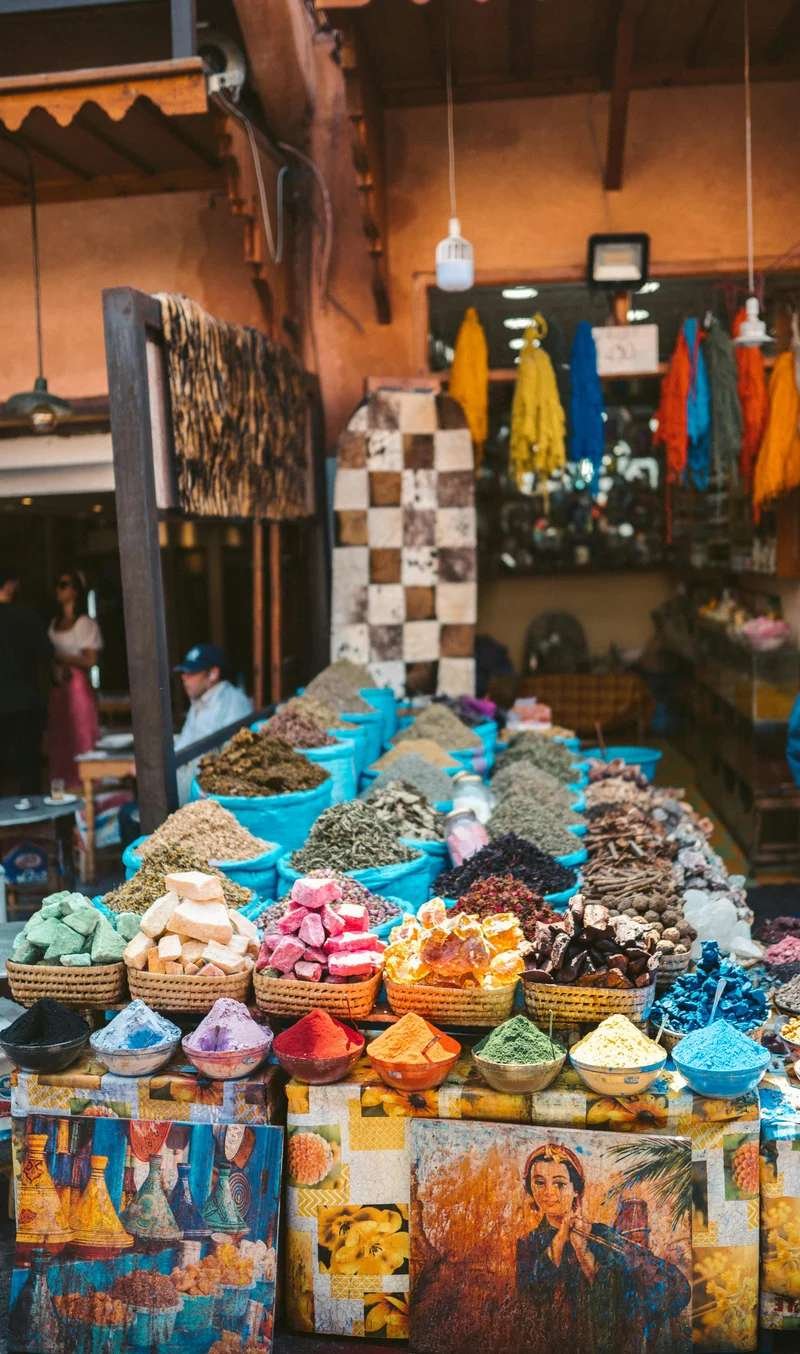
Herbalists and "Berber pharmacies". A demonstration of oils and spices, warm and knowledgeable, ending at a counter, with prices frequently multiples of the same goods in a working spice souk. Saffron is where a test is easiest: real threads give their colour to warm water slowly while staying red, whereas safflower and turmeric flood the glass at once and go pale doing it. A seller with nothing to hide will run that test for you. Treat the medical framing with more care than the prices: anything recommended for a child, or any essential oil offered to be swallowed, deserves a flat no.
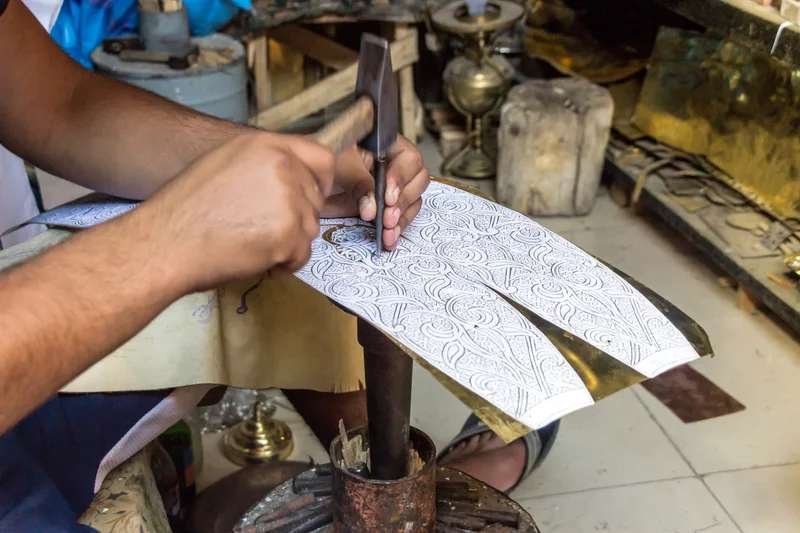
Pottery and thuya wood. Lower value per sale, so the stops are shorter, but the arrangement is identical. Thuya burl is local to the Essaouira region and the carving is skilled work; the objection is to the arrangement, never to the craft.
Restaurants. Less discussed and just as real. A driver who insists on one roadside restaurant in an area with several is often eating free. The markers are consistent: a coach park bigger than the dining room, a laminated menu in several languages with photographs, and no Moroccans in it. Name the place yourself the evening before, or ask the driver where he would eat if he were paying, a question that gets a straight answer surprisingly often, because it releases him from the script.
Riads, concierges and hotel desks. The same mechanism reaches into where you sleep. A property that arranges your excursion, your hammam or an introduction to a carpet dealer may be earning a referral fee, and the fee sits inside the price you are quoted. This is not automatically bad; a good riad's recommendations are its reputation. But the question is the same, and asking it politely costs nothing: "Do you receive anything if we book through you?"
Recognising the pattern matters more than memorising the list. Three markers together are close to conclusive: the stop was not named in writing before the day, nobody gave it a duration, and the way out runs past a payment counter.
The Carpet Room
Carpets carry the highest commissions in the trade, and the room is built around that fact. An extended presentation, mint tea, and an unhurried atmosphere are the tools of a sale worth several hundred dollars or more.
The sequence is stable. You are seated facing the floor, with the door behind you. Tea arrives. A helper unrolls pieces in ascending order of price while the seller watches your face more closely than he listens to your words. Nothing is priced until you have admitted that you like something, and by then a quantity of somebody's labour is lying open in front of you, doing the work an argument would otherwise have to do.
Decode the vocabulary before you sit down. "Sabra", or cactus silk, is overwhelmingly viscose rayon: a pleasant fibre, and not silk. "Vintage" often means a new rug chemically washed to soften its colour. "Antique" is a claim, not a description.
What determines value is duller and checkable. Turn the rug over: on hand-knotted work the pattern is as legible from the back as the front, and the knots are visibly irregular. Compare the base of the pile against the tips, because naturally dyed wool graduates as it fades while synthetics stop dead. Rub a damp white cloth across it and treat transferred dye as a bad sign. None of this needs expertise, only that you are allowed to do it slowly, which is itself the test.
Two things cost people more than the haggling does. A rug that has to be shipped is a rug you cannot check against the one you chose. And the card terminal here will often offer to charge you in your own currency: decline, and pay in dirhams, because that convenience rate belongs to the shop's payment provider.
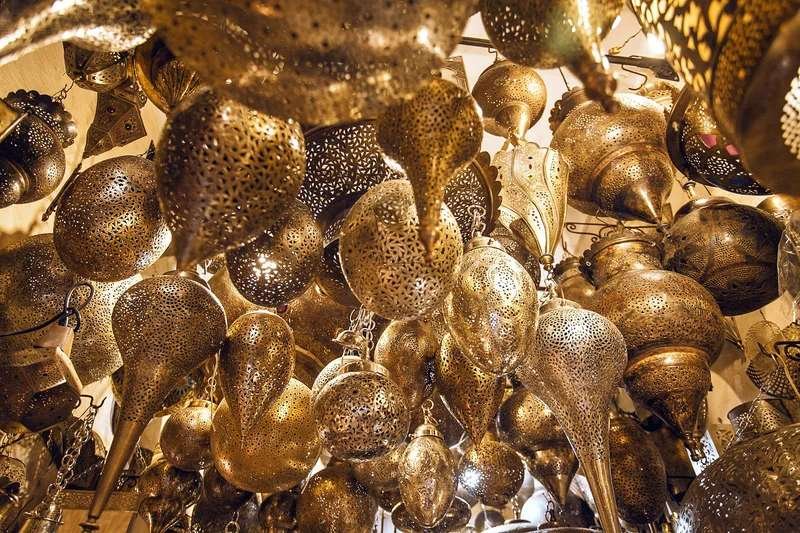
Lanterns and worked brass are the same room at a lower ticket. Machine-stamped piercing repeats perfectly, while hand-chased work carries tool marks and slight asymmetry between repeats. That irregularity is what the price is for.
The Pressure Has a Season
In the spring and autumn peaks the road is busy and the room is working through a queue. A party that does not buy is replaced quickly, and the sit is shorter for it.
In the quiet stretches — the deep heat of summer, the weeks after the school holidays — the same room may see very few visitors in a day, and all of it is aimed at you. Expect more tea and a seller with more time than you have.
The rug is worth the same in either season. Only the length of the sit changes.
The Tea, and How to Leave Without a Scene
The tea is genuine hospitality and it is also a clock. Knowing that is what lets you accept a glass without owing anything for it.
Separate the culture from the setting, because travellers routinely blame the wrong one. Moroccan hospitality does not require a purchase; in a home the same tea arrives with no expectation whatsoever. The suggestion that leaving empty-handed insults it is a sales technique borrowing a country's manners.
Most of the difficulty is settled before you sit down.
Say at the door whether you are buying. Once, warmly, at the start: "We're very happy to look. We're not buying today." A seller told this at the beginning usually relaxes and spends his effort on the next party. A seller told it at the end has spent an hour on nothing and will let you see it.
Do not ask the price of something you will not buy. In this room a price question is an opening bid.
Do not let the unrolling start. Once the floor is covered, leaving becomes a public act performed in front of the man who covered it. "Please don't take anything down for us" works while the shelves are still full.
If asked to name a number, name a real one or none at all. "What would you pay?" invites you to bid against yourself. Either state the figure you would hand over and hold it, or decline: "I'd be guessing, and I don't want to waste your time."
The exit itself is mostly sequence. Thank the person, finish the tea, say your prepared sentence, then stop talking. Every extra reason is an objection, and the room is built to answer objections. Do not buy a small thing you do not want in order to escape: it confirms that pressure works and lengthens the stop for the party behind you. Leave no lead behind either: no promise to return tomorrow, no card taken to be polite, no hotel name. If someone will not let it go, step outside, where the dynamic changes immediately.
The Sentence to Have Ready
Prepare one line before the door and use it as you come in, not on the way out: “Thank you — we're happy to look, but we're not buying today.”
Said at the start it is information, and it is received as such. Said after an hour of tea and unrolled rugs, the identical sentence sounds like a verdict on the seller — which is what makes the last minutes uncomfortable.
Then stop explaining. Reasons are objections, and objections have practised answers waiting for them.
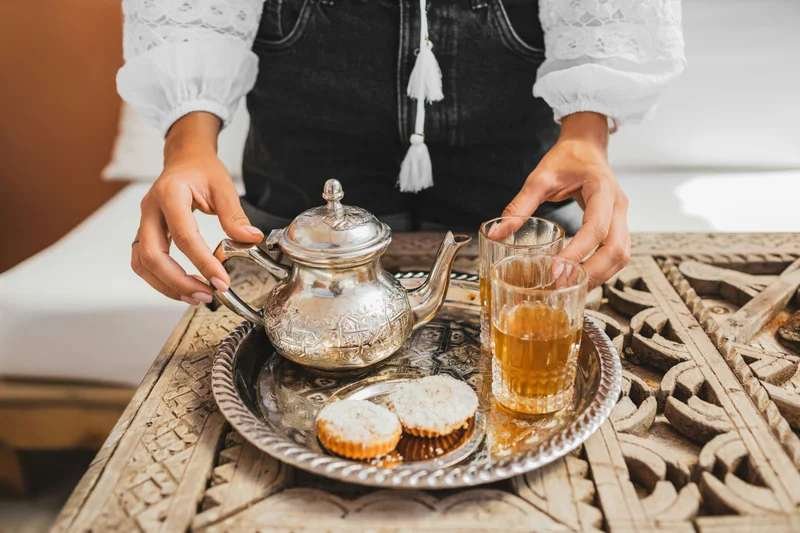
How to Buy Argan Oil Well, If You Want It
Wanting the oil is entirely reasonable. It is a good product with a working local economy behind it.
It helps to know what a good purchase feels like, because most people have only had the other kind and assume the discomfort is normal. You chose the place and the hour. Nobody is waiting for you outside. You can smell before you buy. The price is written on the item, and it is the same price if you walk out and come back later.
Buy it near where it grows, if your route allows. The argan tree grows in southwestern Morocco, and a day on the coast puts you in the region itself, not on the road through it. A Day in Essaouira is 2h35 each way from Marrakech, which is why the day is built around the hours on the coast and the driving is kept as short as it can be.
Buy on weight and smell, not packaging. Culinary argan is roasted and smells nutty. Cosmetic argan is unroasted and nearly odourless. Anything strongly perfumed has been cut or scented.
Read the bottle before you read the label. Argan degrades in light, so dark glass tells you the packer expects the oil to be used; look for a pressing date and a lot number. Buy a small bottle first, because culinary argan oxidises once opened and turns flat. To test a producer properly, buy amlou — argan, almond and honey — where freshness shows immediately.
Be sceptical of the very cheapest. Genuine hand-processed oil carries a real labour cost. Oil well below the going rate is usually diluted with a cheaper carrier oil.
And separate the two decisions. Buy because you want the oil, in a place you chose — not because a stop appeared on your itinerary and a room full of people is waiting to see what you do.
Verify the Cooperative Before You Travel
If a genuine cooperative visit matters to you, do the work at home, not at the roadside. Ask your operator for the registered name in French or Arabic, not the English signage, and search it before you go.
Then ask by email whether they sell on site, what their hours are, and whether your driver is willing to go there specifically.
If the answer is that the route does not allow it, that is useful information: the day was built around a different stop, and you now know which one.
What We Do About It
We take no commission from any shop, cooperative, restaurant or supplier, on any day we run. Our drivers are paid for the day. Their income does not change based on where you stop or what you spend, so there is no reason for them to steer you anywhere.
A policy is only as good as its enforcement. The day rate is agreed beforehand and does not move, an unscheduled retail stop ends a driver's working relationship with us, and if one appears anyway we would rather hear about it that evening than in a review three weeks later.
That is why our days are priced as a flat rate for the party rather than per head: the whole cost is visible at the start, and nothing further is recovered from you along the way. You can see the shape of each one on our Signature Days, or build your own from the catalogue of experiences. All 38 of them carry a duration and a price before you book — precisely the disclosure this article asks of everyone else.
If shopping is part of what you want, we would rather do it properly than pretend it is a cultural visit. Our collector's day puts you with someone whose fee is paid by you and by nobody else — the only arrangement under which buying advice is worth anything. The same principle runs through the individual sessions: A rug session with a curator runs 2h at 320 USD for the party, and A private leather atelier visit is 260 USD. You pay us for the expertise, the workshop's price stays the workshop's price, and we take nothing from the workshop. An adviser paid by the seller is the argan stop again in better clothes.
We are also the wrong choice for some people. If shopping is the entire point and the budget is modest, you do not need us: a taxi to the edge of the medina, an unhurried afternoon in the souks where Moroccans actually buy, and the tests above will serve you better than anything we sell.
Before You Book Any Day Trip
Frequently Asked Questions
- Are argan cooperatives on Marrakech day trips a scam?
Most roadside stops branded as cooperatives are private shops that pay the driver a commission, typically 20 to 40 percent of whatever you spend. That is not fraud, and the oil is often genuine, but it is a sales stop rather than a visit, and you pay for the commission in the price. Genuine women's cooperatives exist, are registered, and can be verified by name and registration number before you travel.
- How much commission does a driver get from a shop stop?
The standard range quoted across the Moroccan trade is 20 to 40 percent of your total purchase, paid to the driver or guide who delivered you. On carpets it can be higher. The commission is built into the shelf price, so the same item is cheaper where no one is being paid to bring you.
- Can I ask my driver to skip the argan stop?
Yes, and a good operator will confirm it in writing before the day. If the stop is how the driver is paid, the request tends to be met with a detour anyway, so the reliable fix is to book a day where the driver's income does not depend on where you shop. Ask whether the company takes any commission from any supplier, and ask for the answer in writing.
- How do I tell a real argan cooperative from a commission shop?
A genuine cooperative is a registered legal entity, usually a women's cooperative under Morocco's cooperative law, with a name and registration you can check. Practical signals: women visibly cracking nuts and grinding by hand, not a demonstration table by the door, prices that are not negotiable, no commission-driven pressure, and a willingness to tell you exactly where the nuts were harvested. Volume matters too. A shop on a main tourist road selling to hundreds of visitors a day is not producing that oil by hand on site.
- Is argan oil cheaper in Marrakech or at a roadside cooperative?
Neither is reliably cheapest. Roadside stops on the main day-trip routes carry commission in the price. Medina shops vary widely and depend on your negotiation. The lowest prices for genuine oil are usually at cooperatives in the argan-growing region itself, around Essaouira and the Souss, where you are buying near the source and not on a coach route.