What a Private Day From Marrakech Costs, Divided by the People in the Car
A private day from Marrakech is priced for the car, not for the seat. That single fact explains almost every confusing price comparison you will make while planning, because a marketplace listing and an operator's site are answering two different questions. One is "what does one person pay". The other is "what does this day cost". Until you divide the second by the size of your party, you are not comparing anything.
Here is the division, done on our own live rates. Nothing below is a worked example. A day out to Aït Benhaddou is 950 USD for the party. For two people that is 475 USD each. For four it is 238 USD each. For six it is 158 USD each — for the same car, the same driver, the same day.
The Two Pricing Models
Why the Car Is the Cost
Most of what you are paying for on a day out of Marrakech does not scale with the number of passengers.
The vehicle costs the same to run whether one person sits in it or six. So does the driver's day. So does the fuel to Aït Benhaddou and back, the tolls, the parking. Doubling the passengers does not double the cost; it buys a larger vehicle. Our day rates make that plain: a Mercedes E-Class or equivalent carrying up to 3 passengers is 180 USD for the day, and a Mercedes V-Class carrying up to 6 is 280 USD.
Some costs do scale with people: entry tickets, restaurant covers, anything priced per head. So comparing private against shared is really two comparisons: the car, where the private model gains as the party grows, and the tickets and the table, where nothing changes whichever way you arrive.
Charge the vehicle per head and four people pay four times for one car. That is a reasonable model for a shared coach, where a seat is a unit of cost and an empty one is a real loss, and a poor one where the vehicle is hired whole.
Where the Two Models Cross Over
For a solo traveller, a shared tour is almost always cheaper. You are buying one seat on a cost someone else is also carrying.
For two, the two prices land close together, and the decision turns on something other than money. The test is whether anything about the day depends on timing, on conversation, or on being able to change your mind at eleven. If nothing does, take the coach.
From about four people, the arithmetic tends to move decisively. A day in the Ourika valley is 550 USD for the party with us: 138 USD each for four, 92 USD each for six. A shared excursion priced per head does not fall as your group grows; it multiplies.
The crossing point arrives earlier than those numbers suggest, because a per-seat price is rarely the whole per-seat cost. The cheaper the seat, the more likely the day recovers the difference elsewhere: a fixed lunch where there is no alternative, an entry fee taken in cash at the gate, a workshop where the coach waits until people have bought something.
Families and groups travelling together are the ones this catches out. Four people on a shared coach are buying four seats on someone else's schedule. The same four in a private car are buying the whole day, and often for a similar total.
Comparing Two Quotes Properly
Before you compare any two prices, establish four things about each:
1. Basis. Is this per person or for the party? A price with no basis stated is usually per person.
2. Party size assumed. A private quote is meaningless without knowing how many it covers.
3. What is inside. Entry fees, meals, and guide fees are frequently outside the headline.
4. What is recovered later. A cheaper day with commission stops is not cheaper. You pay the difference in a shop, at a markup, having lost an hour.
A Half Day Against a Full Day, Without Fooling Yourself
A half day is not half a day's cost and should not be sold as one. The vehicle is still committed and the driver's day is still spent; only fuel and distance halve. An operator charging exactly half either overcharges for the full day or has plans for that afternoon you have not been told about.
The comparison that tells you something is cost per hour on the ground. Ourika Valley and a Berber Table spends 2h20 on the road for 4h in the valley; Aït Ben Haddou and the Atlas Crossing spends 7h20 on the road for 3h30 at the kasbah. Only one of those is a half day in any sense the phrase usefully carries.
So stop asking for a half day or a full day and ask for two clock times: when the car leaves your riad, and when it returns. Those two numbers tell you what the day contains, including whether there is room to add anything.
Adding is where people err in the other direction. Because the vehicle is priced by the day, a short morning experience and a short afternoon one are one day of transport, not two. Medersa Ben Youssef and Le Jardin Secret with a long lunch between them cost those experiences plus one car, not two half-day tours.
The Ground-Time Test
Road time. Both directions, not one. A listing advertising a two-hour transfer is quoting four hours of your day.
Ground time. How long you are at the place, from arrival to departure.
The ratio. If road time exceeds ground time, the day needs a reason beyond the destination — an early departure, or a night at the far end.
What the Price Covers
A day price that does not itemise is hiding either an inclusion or an omission, and both cost you.
Ours cover the vehicle for the day, the driver, fuel, tolls and parking, and the experiences the day is built from. Entry fees, meals and optional extras are stated separately, never folded into a round number. A folded quote looks tidy and cannot be checked against anyone else's.
Watch two words that are not synonyms: included means we have paid for it, not charged means there was nothing to pay. A quote listing both under one heading is making itself look fuller than it is.
A third category rarely appears in a price at all and for Gulf travellers frequently decides the day: prayer, privacy, and what is on the plate. These are attributes an experience either has or does not, published on the experience itself. 16 of ours are marked "Prayer stop included" and 21 are marked "Arabic-speaking guide". What that means on the road is set out in prayer, privacy and food on a day outside Marrakech.
The line that matters most is the one almost nobody writes down: nothing is recovered afterwards. We take no commission from any shop, cooperative or restaurant, which means the price you agree is the price of the day. If you want the mechanism behind that sentence, we set it out in how commission works on a Marrakech day trip. It is the single largest hidden cost in the category, and it is invisible precisely because it is charged to you somewhere else.
What a Quote Should Itemise, and What a Round Number Hides
A round number is a decision, not a coincidence. Real costs do not add themselves into round numbers; somebody rounds them, and rounding travels in one direction. That is not dishonest in itself. It does mean that once the parts are folded together, nobody outside the company can take them apart again.
So an itemised quote survives a test a round one cannot. Ask what the price becomes if you drop one stop. A specific number means the quote is real; "the price is the price" means you are looking at a bundle with a story attached.
Ours is the catalogue. Each of the 38 experiences carries its own duration, transfer time and price, and a day is those experiences plus one vehicle. Medersa Ben Youssef is 230 USD; Le Jardin Secret is 220 USD. Take one out and the day costs less by exactly that.
Three things a round number most often hides:
A "from" price. A headline beginning with "from" describes the cheapest version of itself: the largest party, the shortest day, the quietest season. Ask what it becomes once your party size and your dates are in it.
The currency, and who carries the conversion. Our rates are published in US dollars so that a family comparing us from Dubai, Riyadh and London reads the same number. What changes your total is the currency the payment is finally taken in and whose rate is applied.
How children are counted. On a flat party price a child occupies a seat and changes nothing. On a per-person price a child is a discounted head, cheaper than an adult but still another line on the bill.
Six Lines a Day Quote Should Carry
If a quote does not separate these, ask for the version that does.
1. The vehicle and driver for the day.
2. Fuel, tolls and parking, named either way.
3. Each experience, priced on its own.
4. Entry fees, per site, marked included or not.
5. Meals, with whether the table is reserved and the menu fixed.
6. Commission — what the operator receives from any shop you will be taken to. Ours is nil, in writing.
Distance Costs More Than People
If you want to change what a day costs, change where it goes — not how many of you go.
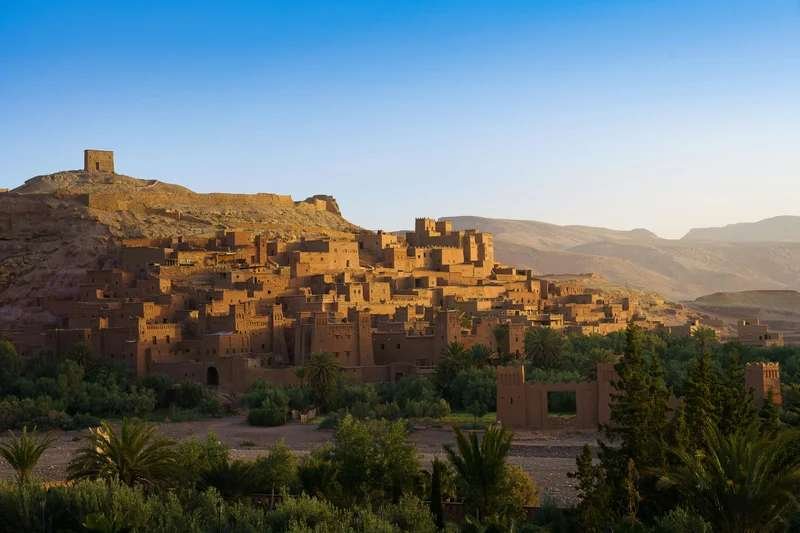
The gap between a short valley day and a long crossing of the Atlas is mostly hours and kilometres. Ourika Valley and a Berber Table sits 1h10 from the city and prices at 550 USD for the party. Aït Ben Haddou and the Atlas Crossing is 3h40 each way over the Tizi n'Tichka and prices at 950 USD. The difference is not a better day, only a longer one: more fuel, more driver hours, a harder road.
Put road time next to ground time and the trade stops being abstract: 7h20 in the car buys 3h30 at the kasbah. It can still be an excellent day, but it is a driving day with a monument in the middle of it. There are two ways round it. Sleep at the far end, so the drive becomes a transfer and not a return; or take the nearer day and spend the difference on the ground. If it is desert rather than distance you are after, we compare the near and the far option in Agafay or the Sahara.
That is worth knowing before you book, because a long day bought on price alone is frequently the day people enjoy least, and it is a trade several standard itineraries make on your behalf without saying so.
The Same Distance Buys Different Amounts of Day
June to early September. Heat, not price, shortens a long day. Mid-afternoon is unusable in the south, so a distant day has to start very early — or be swapped for a nearer one.
December to February. The Tizi n'Tichka can hold snow. It is rarely closed for long, but it slows, and a driver who says the pass is fine in every condition is telling you what you want to hear. The day rate does not change when the road does; the itinerary should.
Ramadan. Mid-afternoon roads are quiet and the hour before iftar is not, so the return to avoid is the one timed to arrive at sunset. Day trips from Marrakech during Ramadan covers what shifts.
The Two Risks Nobody Prices: Overrun and Prepayment
Every day-trip price carries two risks the number itself does not describe: what happens if the day runs long, and what happens to your money before the day starts at all.
When the day overruns. A price quoted as a window — so many hours, then an hourly rate — moves the risk of a slow day onto the traveller at the worst moment: tired, far from the city, negotiating with the person driving. Our vehicle rates are day rates: a Mercedes V-Class is 280 USD for the day, not for a window.
Days do overrun, and almost never for reasons the traveller caused: a souk that fills late, roadworks on the Tichka, a kitchen that is cooking rather than reheating. So ask what the overage rate is and who decides when the clock started. If one exists, you have been handed an incentive to hurry. The limit on our side is that a day rate is still not an unlimited day: a mountain road after dark with a driver who started at six is not a thing to buy cheaply, so we build the day to end before that point.
What you pay before you travel. A deposit buys the operator certainty and working capital. What it costs you is that your money sits in someone else's account, usually in another country, before anybody has driven anywhere — after which the cancellation terms decide whether it returns, in which currency, minus which fees. If you cancel, the operator has lost a day they could have sold. If they cancel, you are pursuing a refund from abroad, in a second language, from a company you found on a listing page.
We take no prepayment. We hold the day and take payment when it happens; the no-show risk is ours. What we ask in return is a confirmation you intend to keep and a message the moment plans change.
Four Questions Before You Send Money
1. How much up front, and to whom? A named company with an address, or a personal account? The second is not automatically a fraud, but it is automatically your risk.
2. In which currency, and at whose rate? The advertised price and the amount leaving your account are two different numbers if nobody says otherwise.
3. What is the cancellation window, in hours? Free cancellation with no stated cut-off is not a term.
4. If they cancel, is it a refund or a credit? A credit is a loan you did not agree to make.
When Private Is Not Worth It
There are cases where the private premium buys you very little.
Travelling alone on a common route. One person on a well-served route is paying for a whole car. Unless privacy, timing or comfort matters to you specifically, it is a lot to pay for control.
Short distances inside Marrakech. A day spent entirely within the medina rarely needs a vehicle at all. Walking is faster and taxis cost very little.
A fixed, popular, single-sight day. If you want exactly what a coach does, at the time a coach goes, a coach will do it for less.
A day whose point is other people. Some things are better with strangers in the room. If the social dimension is the experience, buying it privately removes what you came for.
The private premium is worth paying when the day is long, when the group is more than three, when the timing matters — a sunrise, a market that empties by ten — or when who is in the car with you is part of the point.
There is also a middle position almost nobody considers, and it is usually the right one: buy the car privately for the days that need it and use the city's own transport for the days that do not. One long day out of Marrakech with a driver who knows the road, plus three days of walking and petits taxis, is a better-shaped week than five uniform private days, and a cheaper one.
The Practical Shape of It
Fill the vehicle. Nothing else moves the per-person figure as much, and it costs nothing to do.
Compare like for like. A private full day and a shared half day are different products with different prices, and a comparison between them tells you nothing.
Ask what happens to the price if the day runs long. Ours are day rates, so an itinerary that overruns does not become an invoice.
Book the distance you can absorb rather than the one you can afford. Budget rarely decides whether a long day works; the tolerance of the least patient person in the car does.
Say who is travelling when you ask for a price: ages, mobility, who tires first. None of that changes the number. All of it changes the day.
You can see the shape and the flat price of each of our days on the Signature Days, or take the catalogue and build a day of your own — every experience there carries its duration, its transfer time and its price, so you can do this arithmetic yourself before you speak to anybody.
Reading a Day-Trip Price
Frequently Asked Questions
- How much does a private day trip from Marrakech cost?
A private day is normally quoted as one price for the whole party rather than per person, so the cost per head depends entirely on how many of you travel. A day to Aït Benhaddou is 950 USD for the party, which is 475 USD each for two people and 158 USD each for six. A shorter day in the Ourika valley is 550 USD for the party, or 138 USD each for four. The vehicle, driver, fuel and road tolls are the fixed part of that figure, which is why it barely moves when you add passengers.
- Is a private tour cheaper than a group tour in Morocco?
Per head, group tours are cheaper for one or two travellers and private days are usually cheaper from about four upwards, because a private price is fixed for the party while a group price is multiplied by every passenger. The crossover point depends on the specific day. Beyond price, the two products differ in what you control: departure time, pace, and whether the itinerary includes commission shopping stops.
- What is included in a private day trip price from Marrakech?
Ours include the vehicle for the day, the driver, fuel, road tolls and parking, plus the experiences named in the day itself. Entry fees, meals and anything optional are stated separately rather than folded in, so you can see what you are paying for. Nothing is recovered later through shopping commission, because we take none.
- Why do private day trips quote a price for the car rather than per person?
Because most of the cost is the car. A vehicle, a driver, fuel and tolls cost the same whether one person sits in it or six, so quoting per head would mean charging four people four times for a cost that occurred once. Per-person quoting suits shared coaches, where each seat genuinely is a unit of cost.
- How many people can share a private day trip from Marrakech?
It depends on the vehicle rather than the experience. A sedan seats up to three passengers comfortably for a full day at 180 USD for the vehicle, a V-Class up to six at 280 USD. Since the day is priced for the party, filling the vehicle is what brings the per-person figure down, and a family of six pays roughly the same total as a couple.