Day Trips From Marrakech in Ramadan: What Runs, and When
Ramadan does not stop day trips from Marrakech. It rearranges their hours. Of the 38 experiences in our catalogue, 35 run during the month and only 3 stop. The problem visitors hit is not closure but scheduling: a day designed on ordinary hours runs into a monument that shut at four, a workshop that closed before iftar, and a restaurant that serves nothing until sunset.
This is also the information that is hardest to find. Pages ranking for Marrakech day trips either ignore Ramadan entirely or offer one general warning. We run these experiences during the month, so we know which ones move and where they move to.
Two clocks run in Ramadan, and confusing them is what wrecks an itinerary. The first is fixed and public: the meal before first light, the day's prayers, and the moment at sunset when the country stops and eats. The second is commercial — the hours each monument, workshop, restaurant and driver sets for itself in relation to the first — and nobody publishes that one. It is reconstructed each year by the people who work inside it. This article is the second clock.
Ramadan At a Glance
What Stops, and Why
3 experiences in our catalogue do not run during Ramadan, and every reason is about food rather than a locked door: Afternoon Tea at La Mamounia, A cooking class in a Berber home and Mountain Biking around Asni.
Afternoon tea at La Mamounia stops because the service itself is replaced by an iftar at sunset. The daytime cooking class in the Ourika stops because the whole point is eating what you have made, which does not work at midday — so an evening version built around the iftar table is arranged instead. The mountain bike ride around Asni stops for two reasons at once: the effort is considerable while fasting, and the village lunch cannot be served in daylight.
3 out of 38 is not many. But naming them is more use than the sentence you find everywhere else — "some activities may not be available" — which tells you nothing and lets the writer avoid checking.
There is a second category nobody names, and it is the one that actually disappoints people: experiences that run but return less than the photograph promised. The rug session happens — the mint tea that opens it moves to after sunset. The hammam happens; the pastries afterwards do not. The garden opens on time; the café inside it, half the reason people go, serves nothing until maghrib. None of that is a cancellation, so none of it appears in anyone's Ramadan notice.
And there is a third category that goes unmentioned because nothing happens to it. Anything outdoors and unhurried is untouched, and the balloon flight is arguably better suited to this month than to any other: it lifts before first light, which in Ramadan falls almost exactly at the end of suhur, so a fasting traveller starts the day already awake and fed.
One detail that is a convenience in an ordinary month becomes structural in this one. 16 experiences in the catalogue include Prayer stop included, and 22 more have Prayer space on site. In Ramadan that is what decides whether a day fits around the prayers or competes with them.
Monuments and Gardens: Shorter Hours, Not Locked Doors
Marrakech's monuments and museums operate through Ramadan on a compressed schedule. The working rule is that hours contract to roughly nine in the morning until four in the afternoon, instead of running into the evening.
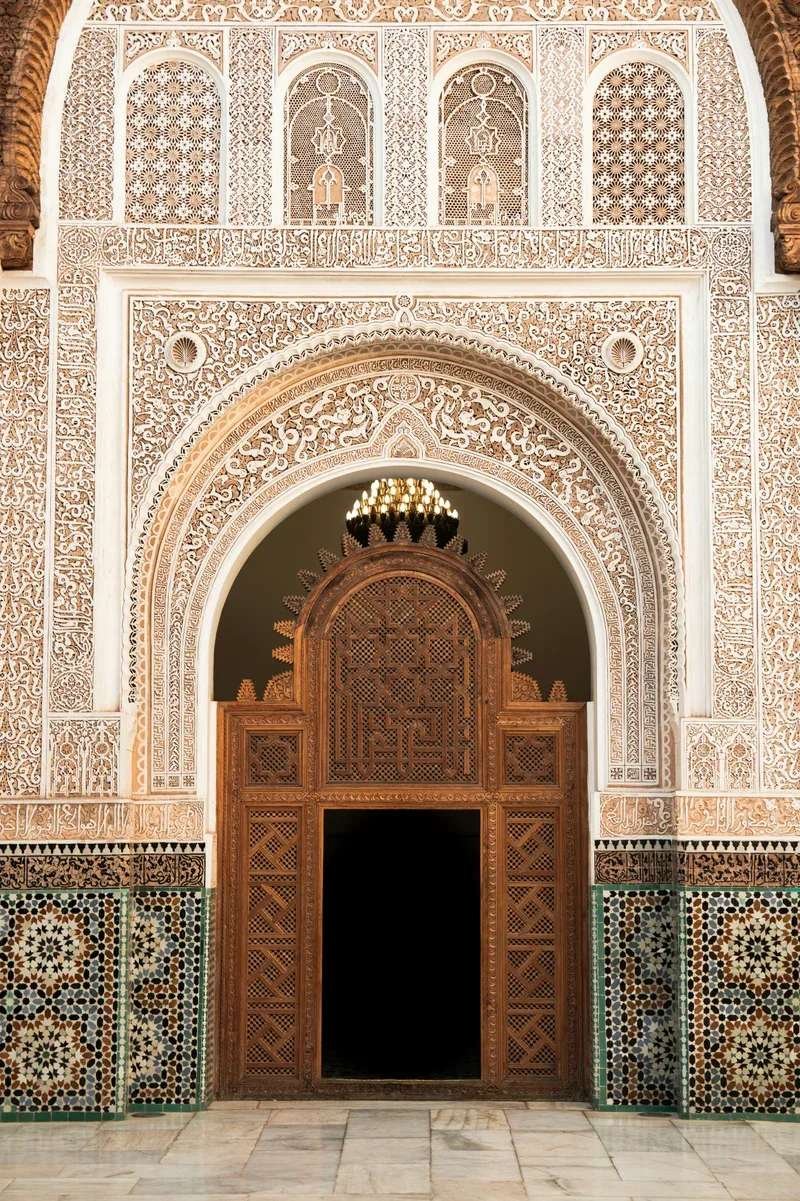
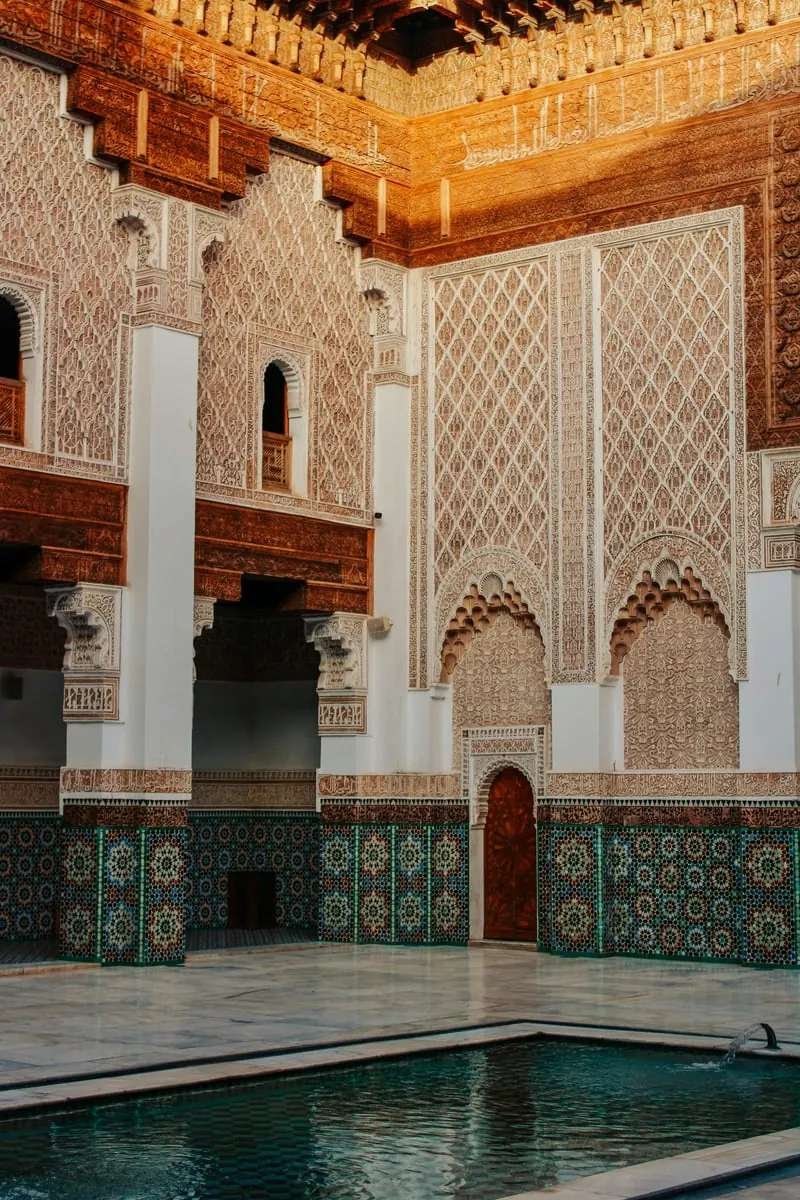
That changes the order of your day more than its content. The Bahia Palace and the Mellah, the Ben Youssef medersa, the Majorelle garden — all entirely possible, provided they sit in the first half of the day. Gardens close earlier. The cafés inside them, which are half the pleasure of the place in an ordinary month, serve nothing before sunset.
The rule we work to: everything inside the city walls is finished by three. After three belongs to rest, or to the road.
Two mechanical details do more damage than the shortened day itself. The first is the ticket desk, which closes before the site does, and in Ramadan closes earlier still because the person selling tickets also wants to be home. Arriving a quarter of an hour before the posted close is the most common way a Ramadan afternoon fails: the door is open, the desk is shut, and nobody can help you.
The second is that compression punishes long lists, not long visits. A short site absorbs a short day perfectly well — Medersa Ben Youssef asks 1h15, Le Jardin Secret about the same, and two of those with a walk between them fill the morning without ever pressing against a closing door. Even 2h30 for Bahia Palace and the Mellah together sits comfortably inside it. What does not survive is the ordinary-month habit of stacking four sites and trusting the afternoon to absorb the overrun. In Ramadan there is no afternoon to absorb it.
Ask for the Hour, Not the Day
Published Ramadan hours are unreliable everywhere in Morocco, official pages included. The fix is in how you ask.
Ask a time, not a yes or no. Not “are you open tomorrow” but “what time do you close, and when does the last ticket go on sale”. The second question is the one that saves the afternoon.
Ask the site itself. Ramadan hours are set locally and move through the month; nothing that scrapes them is current.
Ask again for the last ten days. Hours fixed at the start of the month frequently change for the final stretch.
Souks and Workshops: A Different Window Entirely
This is the change that surprises visitors most.
Souks open later than usual and thin noticeably an hour or more before sunset, when everyone turns to the meal. Artisan workshops — coppersmiths, leather workers, wool dyers — keep shorter hours, and the dyers' souk winds down by mid-afternoon.
In practice, a medina walk with us during Ramadan starts around nine and ends around three. A rug session or a leather atelier visit is booked for late morning instead of the afternoon. And the tea normally served during a rug session moves to after iftar — a small adjustment that changes the mood of a visit considerably if nobody mentions it in advance.
The mechanism behind that is worth understanding, because it predicts every workshop you will visit this month. An artisan who is fasting works the morning at full pace, loses the edge somewhere in mid-afternoon, and shuts in time to be home. The closing hour is not negotiable and has nothing to do with you. The morning is therefore not merely the better time to come; it is the only time you will see a workshop working rather than winding down, which is the point of going at all.
So ask the shop two questions, not one: what time it closes, and what time the master stops working. Those answers routinely differ by an hour or more, because a shutter can stay up with an assistant behind the counter long after the person you came to watch has gone home.
Buying moves in a direction that surprises people. The second half of the month is the busiest retail period of the Moroccan year, with households buying for Eid, so prices in the souks firm up instead of softening and negotiations run shorter and more direct than the ritual you may have read about. If you intend to buy something considerable, buy it in the first half of the month, in the late morning.
Suhur, and the Two Hinges of the Day
Every Ramadan day in Marrakech turns on two moments, and most scheduling mistakes are a failure to respect one of them.
The first is suhur, the meal before first light, and its practical consequence runs against instinct: a Ramadan departure can be earlier than an ordinary one, not later. A party that is fasting is awake and fed before dawn anyway, so leaving at that hour costs nothing and buys the coolest air, an empty road, and the first slot at whatever you are driving towards. On the distant days this decides the matter. Aït Ben Haddou and the Atlas Crossing sits 3h40 from Marrakech, which is 7h20 on the road before you have looked at anything — demanding in any month, and simply unworkable if you start at nine.
How early is too early is a question about sleep, not about sunrise. A party that rises for suhur and leaves immediately is running on a night broken in two. That is fine once. It is not fine three days running, and the failure shows up as a wasted day, not a tired one. We schedule a single pre-dawn departure in any stretch, put a deliberately late start the morning after it, and would rather move a long day to the far side of a rest day than run two back to back.
The second hinge is the last hour before sunset, and it behaves like no hour in the ordinary calendar. Traffic thickens hard as the whole city converges on home, then empties within minutes of the call to prayer. Drivers on the road at that point have not eaten or drunk since before dawn, concentration is at its lowest of the day, and the mood is impatient in a way it never is at other hours.
We treat that as a constraint on the itinerary, not a footnote to it. Long transfers finish with a clear margin before maghrib, not on the hour. When the arithmetic refuses to work, the day gets rebuilt rather than squeezed — a nearer destination, an earlier start, or an iftar at the far end and a calm drive home afterwards, on roads that are for about an hour the emptiest they will be all year.
The Hour Before Maghrib
This is the one part of the Ramadan day we treat as a hard constraint and not a preference.
No long transfer inside it. Roads at their busiest, fasting drivers at their least sharp. We finish the driving with a real margin or we do not begin it.
Nothing booked to start in it. Workshops, guides and riad staff are all turning towards the meal, and anything scheduled there gets a fraction of the attention it would get at eleven in the morning.
Your driver eats too. Whether you break the fast together or he stops for twenty minutes while you wait is worth settling in the morning instead of negotiating it at sunset. Most guests choose to eat together, and it is usually the best half hour of the day.
The Lunch Question, and Its Three Answers
The question most families ask: what do we eat during the day? There are three workable answers.
A packed table. We carry the meal and set it somewhere it is not in front of anyone fasting. This suits mountain and waterfall days best, where terrace restaurants close through daylight in any case.
A hotel table. Hotels and the larger riads serve non-fasting guests through the day. This is the answer when there are small children in the party, or anyone not fasting for other reasons.
Building the day around iftar. In our view the best of the three. Instead of treating the meal as a problem, it becomes the point of the day: monuments in the morning, a pause in the afternoon, then an iftar table at sunset somewhere chosen for it. The entire city does the same thing in the same moment, and it is not an experience available in any other month.
Whichever you take, take it before the day begins. All three need something arranged in advance — a kitchen briefed the night before, a hotel table held, an iftar booked days or weeks out — and none of them can be improvised at the moment hunger arrives, which is precisely when most parties start thinking about it.
The harder version of the question is a party that is split, which is most parties: one grandparent fasting, teenagers not, a small child who obviously is not. The two failure modes are symmetrical. Eating apologetically, in hiding, makes everyone uncomfortable and implies that ordinary behaviour is an offence. Eating visibly in front of a fasting driver or guide through the worst hours of the afternoon makes a long day considerably longer. Nobody will say a word to you about either.
What works is unremarkable and worth stating plainly. Drink water in the car freely; it is private space and nobody thinks twice about it. Eat in the hotel, the riad, the vehicle or a private room, and not on a public terrace. Do not offer food to someone who is fasting, and do not perform your refusal to eat in front of them. Say once, in the morning, who is eating and roughly when, so the day can be built around it instead of around a guess.
Then watch the fasting travellers in your own party, who are the ones most likely to overreach: an ambitious morning, a refusal to stop, and a collapse at four in the afternoon that takes the evening with it. A Ramadan day carries around two-thirds of the content of the same day in another month. The third you leave out is what makes the iftar worth having.
The Long Day During Ramadan
Distant days — Aït Benhaddou, Essaouira, Ouzoud — remain possible during Ramadan, but they need rebuilding, not adjusting:
Leave after suhur, not after breakfast. That buys an hour or two of the coolest air and the emptiest road.
Shorten the stops along the way, because energy drops through the afternoon.
Time the return for iftar in Marrakech, or arrange an iftar table at the destination itself.
What we avoid is long driving in the last hours before sunset. The roads get busy and the drivers are fasting.
Friday, the Last Ten Nights, and Eid
Ramadan is not one set of hours held steady for a month. It has phases, and a trip that crosses a boundary can meet two different cities in the same week.
Fridays run differently in any month, but in Ramadan the effect is amplified. The midday prayer empties the medina for the better part of an hour, shops that opened late close for it and reopen afterwards, and some sites trim the afternoon further still. Friday morning is the best time of the week to be standing inside a monument, and the middle of Friday is the worst time of the week to be trying to buy anything.
The first two-thirds of the month settle into the pattern this article describes. The last ten nights are different in kind: they carry the greatest religious weight of the year, the mosques fill deep into the night, and the city's centre of gravity moves almost entirely after dark. Daytime hours can shorten again without notice, and evenings that were pleasantly busy become crowded. For the quietest possible monuments, come in the first half of the month. For the most extraordinary nights, come in the last ten.
Then Eid, which catches more travellers than any other date in the calendar. The first day of Eid al-Fitr is the closest Morocco comes to a full stop: monuments, museums, shops, workshops and most restaurants outside hotels all close, families are at home, and the streets in the morning are emptier than at any other moment of the year. It is a remarkable thing to witness and an impossible day to sightsee through. We plan it as a rest day, a hotel day, or a driving day between cities, and we say so at the point of booking, not afterwards.
If Your Trip Straddles Eid
Eid al-Fitr is confirmed by moon sighting, so the date is not certain until the night before. Plan for both possibilities, not one.
Keep the first Eid day soft. A spa, a pool, a long lunch inside your own hotel, or a transfer to the next city — not a monument, a souk or a workshop.
Expect the second day to reopen unevenly. Some sites return to normal hours at once; others take another day.
Commit transport early. Eid is the heaviest domestic travel period of the Moroccan year, and the good drivers are spoken for weeks ahead.
The Evening Is Its Own Itinerary
In an ordinary month the evening is what is left of the day. In Ramadan it is the day, and the largest single improvement most visitors can make is to stop treating it as the tail end of the afternoon.
An iftar is not a dinner reservation under another name. The whole city sits down within a few minutes of one another, so service is compressed into a narrow window instead of spread across an evening, kitchens cook to a single fixed moment, and a table booked for the wrong side of sunset is worth very little. The places worth eating in are full for the month, not busy on particular nights.
How far ahead you need to book depends on where. Hotel iftars — the palace tables people travel for — open their books before the month begins and lose the good nights weeks in advance; if a specific one matters to you, settle it when you settle your flights. Riad and restaurant tables want several days and an accurate party size, because the meal is laid rather than ordered. A private iftar in a house or a garden, the version we most often arrange for families, wants a week or more, because someone is cooking for you alone.
Ask three questions when you book, in this order. What time does the table seat — the answer should be tied to sunset and not to a clock time, and if it is not, the kitchen has not thought about the month. Is the meal set or ordered — almost always set, which matters if anyone in the party has a restriction. And is there a second service — many places run one, and the later seating is calmer and much easier with children, at the cost of missing the moment itself.
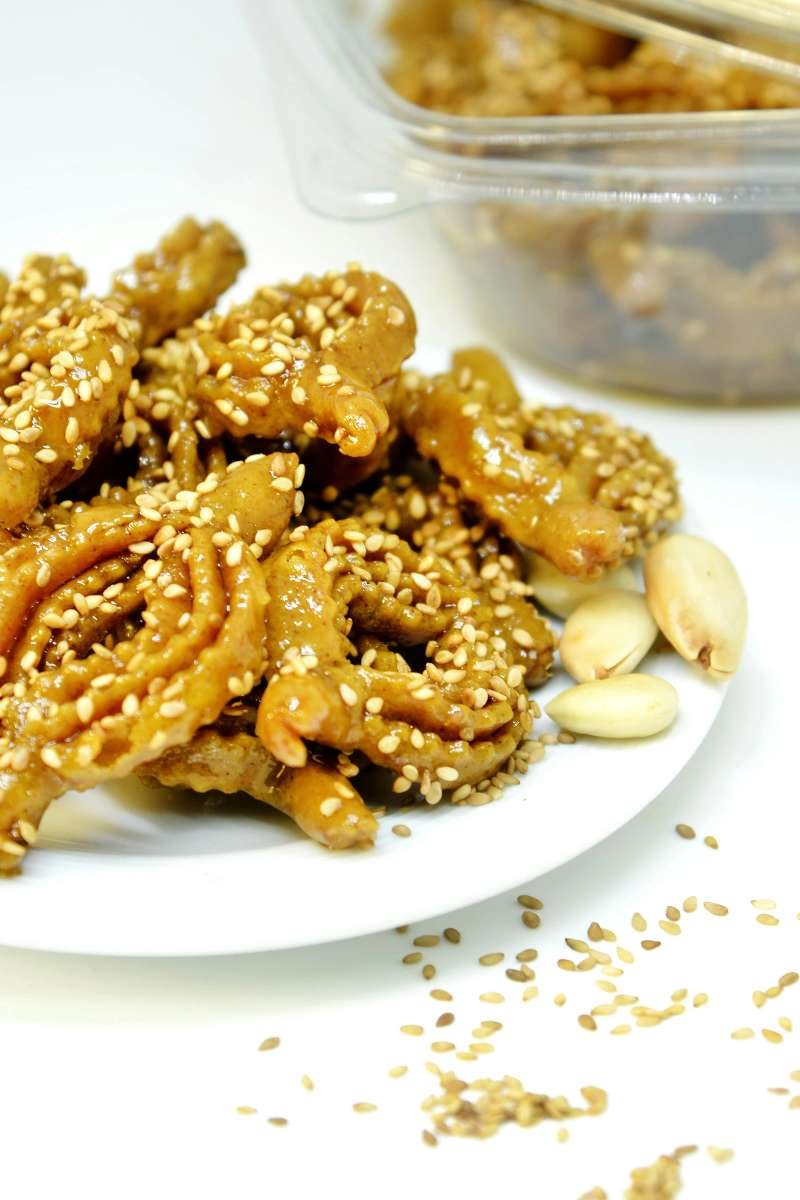
That moment is worth planning around at least once. The street noise drops, then stops. Tables laid for an hour fill all at once. Almost everyone begins the same way, with dates and milk, harira and chebakia, and for about twenty minutes the loudest city in Morocco is silent.
What follows is the part no other month offers. The medina reopens at full strength a couple of hours after the meal and trades well past midnight, the squares fill with families and not tour groups, and the pastry shops do their best business of the year. Shopping at ten at night in Ramadan is a different activity from shopping at noon in April: the sellers have eaten, the crowd is local, nobody is hurrying you. Plan the evening walk deliberately, and go to bed late. Sleeping through the evening is the one reliable way to miss Ramadan while standing in the middle of it.
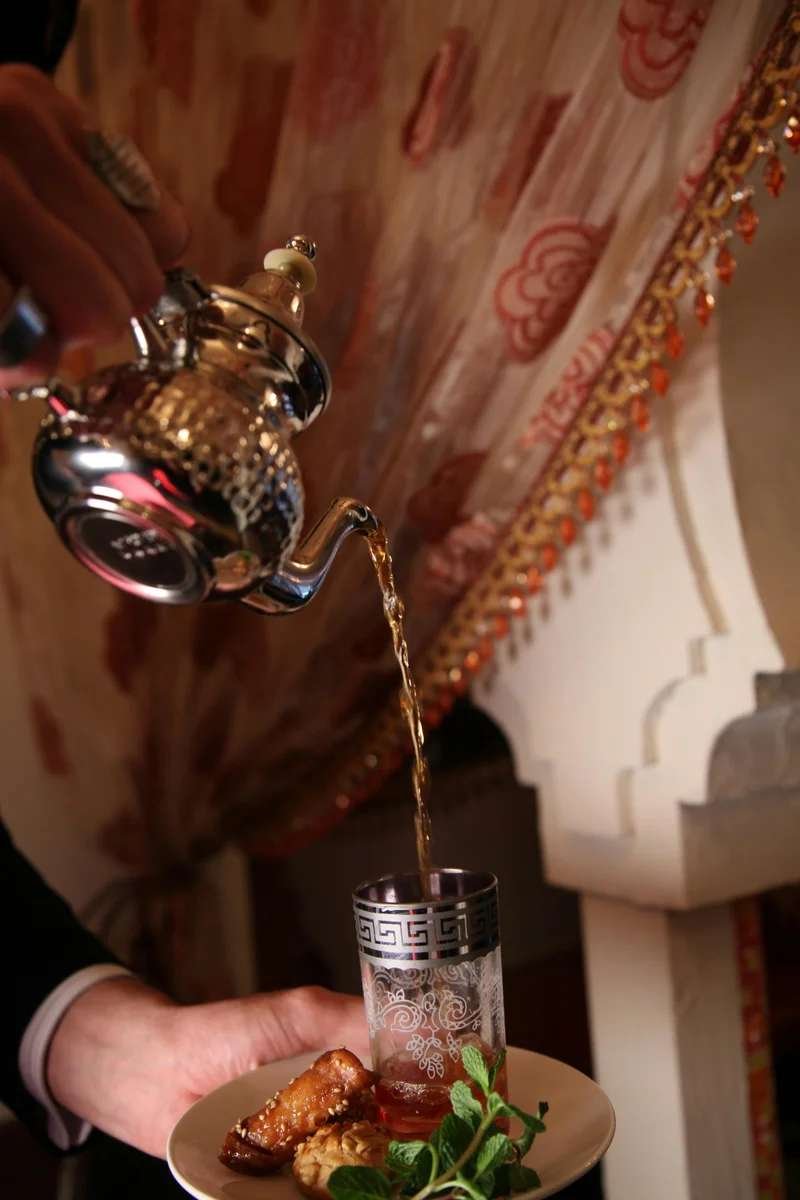
Booking an Iftar Table
The first reservation worth making in a Ramadan trip, ahead of everything else on the itinerary.
Palace hotels: before the month opens. The tables people travel for are committed weeks ahead.
Riads and restaurants: several days, with an accurate party size — the meal is laid, not ordered.
A private iftar in a house or a garden: a week or more, because someone is cooking for you alone.
Confirm the seating against sunset, not against a clock time. A kitchen that quotes you a fixed hour has not planned for the month.
What Gets Better
Not everything that changes is a loss, and some of it is a straight gain.
Monuments are quieter during the day than at almost any other point in the year. Gardens where you would normally wait twenty minutes for an unpeopled photograph are close to empty at ten in the morning.
The roads are lighter. Traffic concentrates into the hour before sunset and then vanishes completely; everything either side is calmer than usual.
And the evening is a different city. After iftar, Marrakech opens late and stays open — souks trading, families in the squares until well past midnight.
The people you want are also available. Ramadan is a soft month for inbound travel to Marrakech, which means the strongest Arabic- and English-speaking guides are not booked out six weeks deep, and hotels that are impossible in April have rooms. Rates follow the same curve for three weeks and then reverse sharply into Eid.
And there is the thing guests mention afterwards that no itinerary can manufacture: for one month the city is doing something together, and a visitor gets to see how Morocco lives instead of how it presents itself.
The Day Shape We Recommend
Start early, between eight and nine. Monuments in their first hours, cooler air, and the quietest version of every place you visit.
Close indoor visits by three. After that the doors narrow and the pace drops.
Take a real afternoon pause. During Ramadan it is not indulgence but part of the design, and for anyone in your party who is fasting it is a necessity.
Then the evening. An iftar booked in advance, and the city afterwards — which is the part people remember from a Ramadan trip more than anything else.
It is worth saying plainly when this month is the wrong choice. If your trip is short and every day has to be a headline day, Ramadan will frustrate you and another month would serve you better. If what you want is long lunches on terraces with a view, that experience essentially does not exist for four weeks. And if you are travelling with very young children on a schedule that cannot bend around an afternoon pause, the arithmetic is against you. We would rather say that before you book than let you discover it on the second afternoon.
Every entry in the catalogue of experiences carries its own Ramadan note: whether it runs, how its timing moves, and what the alternative is when it does not. You can also start from our Signature Days and ask for one rebuilt on the Ramadan clock, which is what we do anyway when the day falls inside the month.
Planning a Day in Ramadan
Frequently Asked Questions
- Do day trips from Marrakech run during Ramadan?
Yes, nearly all of them. Of the 38 experiences in our catalogue, 35 run during Ramadan and only 3 stop. Timing changes far more than availability: monuments shorten their hours, workshops open late and close before iftar, and tables move from lunch to the sunset meal. A day built on the Ramadan clock works well. A day built on the usual clock meets closed doors.
- Which experiences do not run during Ramadan?
3 in our catalogue: Afternoon Tea at La Mamounia, A cooking class in a Berber home and Mountain Biking around Asni. In each case the reason is the meal, not the door — the tea service is replaced by an iftar, the daytime cooking class exists so you can eat what you cook, and the ride is strenuous with a village lunch that cannot be served in daylight. Evening alternatives can be arranged for the first two.
- Do monuments and museums close in Marrakech during Ramadan?
They do not close, but they shorten. Monuments typically run something closer to nine in the morning until four in the afternoon instead of into the evening, gardens shut earlier, and cafés inside them serve only after sunset. The practical answer is to take the first morning slot and finish indoor visits before three.
- Can you have lunch on a day trip during Ramadan?
Yes, though not everywhere. Hotels and most riads serve non-fasting guests through the day, while terraces, souk restaurants and monument cafés stop until sunset. In practice we carry a packed table, book a hotel table, or rebuild the day so the meal is iftar — which is usually the best of the three.
- Is Ramadan a good time to visit Marrakech?
It is a different time, not a lesser one. Days are quieter and monuments far less crowded, and the city comes alive after sunset in a way it does not in any other month. What it asks is that you accept a different schedule: early visits, an afternoon pause, and a long evening. Travellers who try to run their usual day inside Ramadan find it tiring. Those who move with it usually find it the best trip they have had here.