Rabat City Guide: Imperial Morocco Without the Crowds
The Bouregreg reaches the Atlantic under a twelfth-century citadel, and the government of Morocco sits on the hill behind it. Rabat is the imperial city most itineraries leave out, and for a first trip of a week or less that is usually the right decision: no equivalent of Djemaa el-Fna, no tanneries, no maze you can lose an afternoon in. The capital runs in a quieter register. Wide avenues, ministries and embassies, three universities, and a tram that works.
All of it is worth a day, sometimes two, once you know what you are getting. What follows is what Rabat does well, where it falls short, and how to fit it into a longer Morocco trip.
Rabat At a Glance
Rabat sits on the imperial cities belt described in our guide to Morocco's regions, and it is the one people ask about last. If you are still deciding between the headline cities, our Fes and Marrakech comparison is the better place to start. Come back to this once those two are settled.
The Tempo of a Working Capital
Civil servants walk to lunch. Students fill the cafés along Avenue Mohammed V in the late afternoon. The Atlantic keeps the air moving and the light soft in a way that inland Morocco never manages.
The practical consequence is that nobody follows you. In Marrakech and Fes, being approached is part of the experience and you learn to handle it. Here you can walk the medina end to end, look into every shop, buy nothing, and reach the far gate without anyone saying a word. For travellers who have already done Marrakech, that alone can justify the stop.
The medina helps too. It is small, laid out on a rough grid inside its walls, and very hard to get lost in. Rue des Consuls, where foreign envoys once lodged, is its carpet and craft spine and the closest thing Rabat has to a souk. Set against what our souks and medinas guide describes elsewhere, this is the gentle version: fewer sellers, less theatre, much less pressure to commit.
The trade-off is real. Rabat is pleasant and orderly. Nothing here will unsettle you the way Fes does on your first morning, and if being unsettled is what you came to Morocco for, budget your days elsewhere.
Four Sights, and What Each One Takes
UNESCO inscribed Rabat in 2012 as a shared heritage of the historic and the modern city, which is a fair description of how the sights are distributed. These four justify the trip.
The Kasbah of the Udayas
An Almohad citadel raised in the mid-twelfth century on the site of an earlier fortified ribat, guarding the mouth of the Bouregreg where it meets the Atlantic. Inside the walls the lanes are painted blue below and white above, a Moorish-Andalusian habit usually credited to refugees who arrived from Spain.
An hour covers it. Enter through the monumental Almohad gate, wander until the lanes run out at the clifftop platform, then drop into the Andalusian Gardens, which look medieval and were laid out in traditional style in the early twentieth century. The café at the edge looks across the water to Salé. Go late afternoon, when the light comes off the ocean.
Hassan Tower and the Mausoleum of Mohammed V
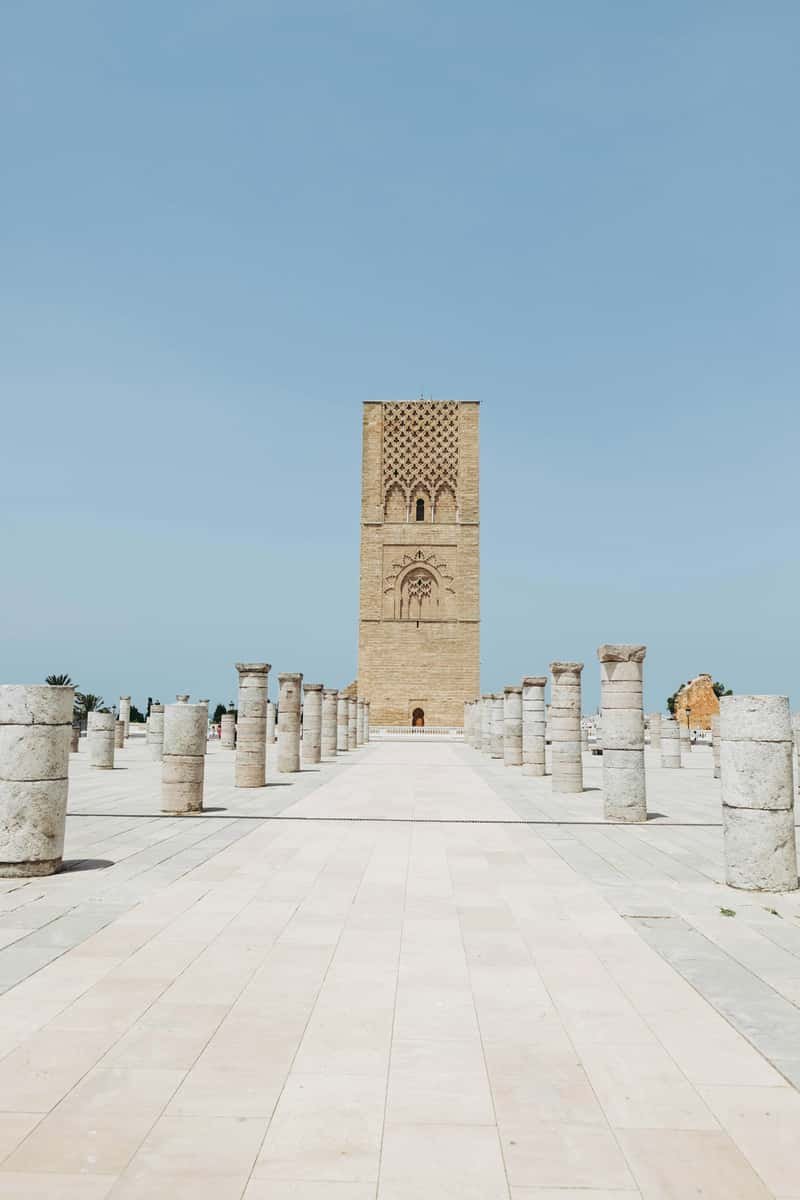
Work began on the Hassan mosque in 1195 under the Almohad caliph Yacoub al-Mansour, who intended the largest mosque in the western Muslim world. He died in 1199 and everything stopped. The minaret stands at 44 metres, roughly half its planned height, above a plaza of 348 truncated columns where the prayer hall was to have been. It is an unusually moving thing to walk through: a plan interrupted, left in place for eight centuries.
Across the same esplanade, the Mausoleum of Mohammed V holds the tombs of the late king and his sons, Hassan II and Prince Abdallah. It is open to visitors, guarded by sentries in ceremonial dress, and finished in the zellige, carved plaster and cedar that Moroccan craftsmen reserve for their most serious work. Dress modestly and keep your voice down; this is a working royal tomb, not a monument.
Chellah
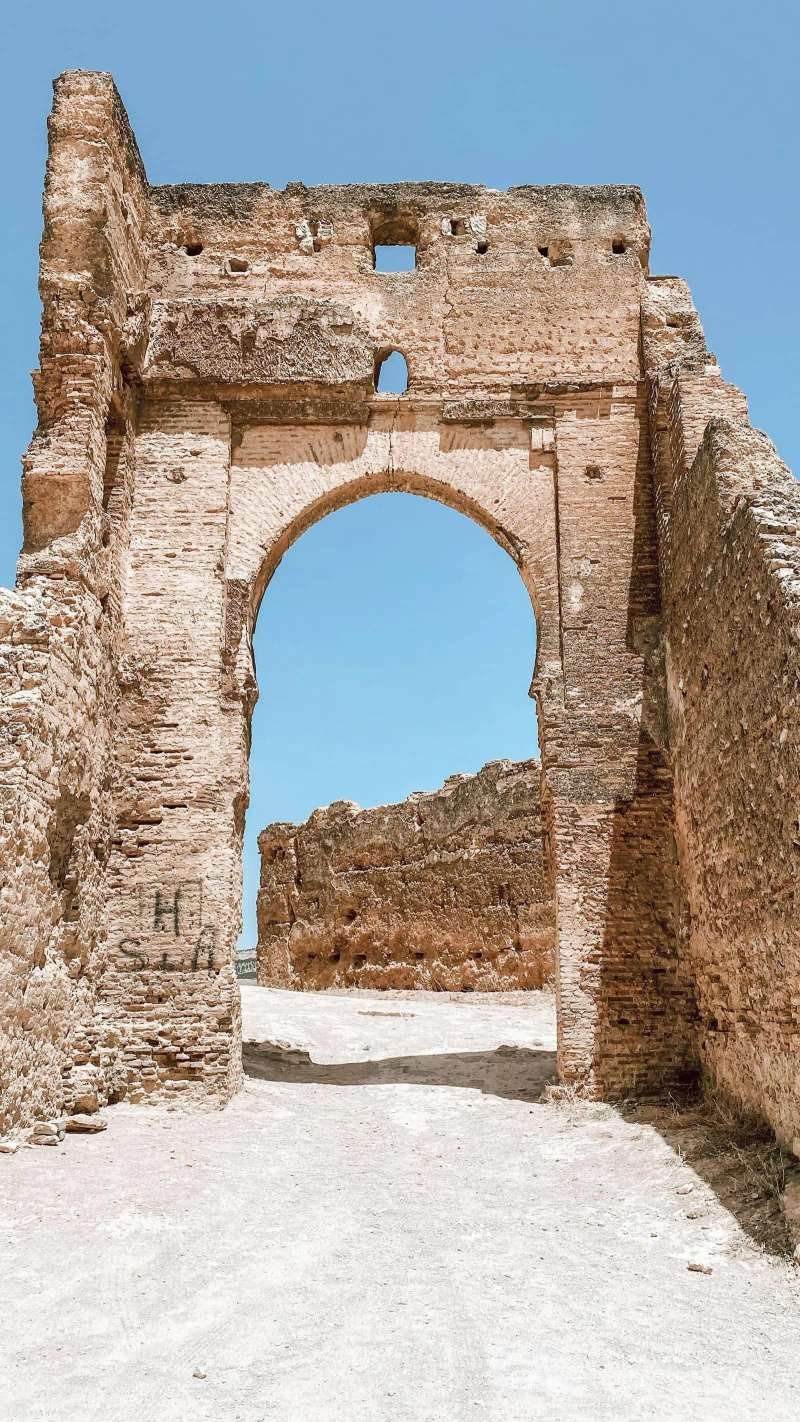
On the southern edge of the city, inside a Merinid wall, sit the remains of the Roman town of Sala Colonia and the fourteenth-century necropolis that Sultan Abu al-Hasan built on top of it. Roman street plan underneath, Islamic tombs and a ruined minaret above, storks nesting on both, gardens growing through the middle of it all.
Chellah reopened after a long restoration that added a proper visitor circuit, and it remains the quietest significant site in any Moroccan imperial city. Late afternoon is best. Allow an hour.
The Museum of History and Civilizations
Small, old-fashioned, and holding the best Roman bronzes in North Africa, most of them lifted from Volubilis, including the celebrated bust of Juba II. If Volubilis is on your route, or already behind you, seeing these changes the site considerably. If Roman archaeology leaves you cold, skip it without regret. National museums here close one day a week, so check before you go.
One More, If You Have the Afternoon
The Mohammed VI Museum of Modern and Contemporary Art opened in 2014 as the first Moroccan institution devoted entirely to modern and contemporary work, and it holds several hundred pieces by Moroccan and international artists. It is the strongest counter-argument to the idea that Morocco is only about tradition and craft, and it takes about ninety minutes.
Across the river, the medina of Salé is rougher and less visited than Rabat's, and the fourteenth-century Medersa of Abu al-Hasan at its heart is encrusted with zellige, carved stucco and cedar. Climb to the roof for the view back across the estuary. The tram gets you there in minutes.
Where to Stay, by Area
Rabat has almost no riad stock worth the name. This is a capital of hotels, not of courtyard houses, and adjusting that expectation before you book saves disappointment. Four areas make sense.
Souissi, the diplomatic quarter, is the established luxury address. The Sofitel Rabat Jardin des Roses sits in rose gardens near the embassies and the Royal Palace, with a large spa and a quiet setting about ten minutes from the centre by car. It suits travellers who want space and calm and do not mind driving to the monuments.
Hassan, the district around the tower, is the choice if you would rather walk. La Tour Hassan Palace has been operating since the protectorate era, overlooks the tower and the mausoleum, and puts the medina within a few minutes on foot. It is more traditional than its newer competitors; if you want contemporary, the marina has it.
The Bouregreg marina, on the water between Rabat and Salé, is the newest development. The Fairmont La Marina Rabat-Salé anchors it, with a waterfront position and views across the river. You are set slightly apart from the older districts, which suits a stay built around the water and adds a short taxi ride to everything else.
Dar Es Salam, in the cork-oak forest south of the city, is a different proposition entirely. The Ritz-Carlton there adjoins the Royal Golf Dar Es Salam, laid out by Robert Trent Jones and long the home of the Hassan II Trophy. It is a resort with a city nearby rather than a city hotel, and it makes sense only if golf or seclusion is the reason for the stay.
Hay Riad, the modern administrative district, holds the international business hotels. They are efficient and well run, but the neighbourhood is offices and car parks. Stay there for a meeting, not for a holiday.
Getting There and Getting Around
Rabat is the easiest imperial city to reach, because the main line runs straight through it. Our transportation guide covers trains, buses, drivers and self-drive across the country in detail; what follows is only what is specific to Rabat.
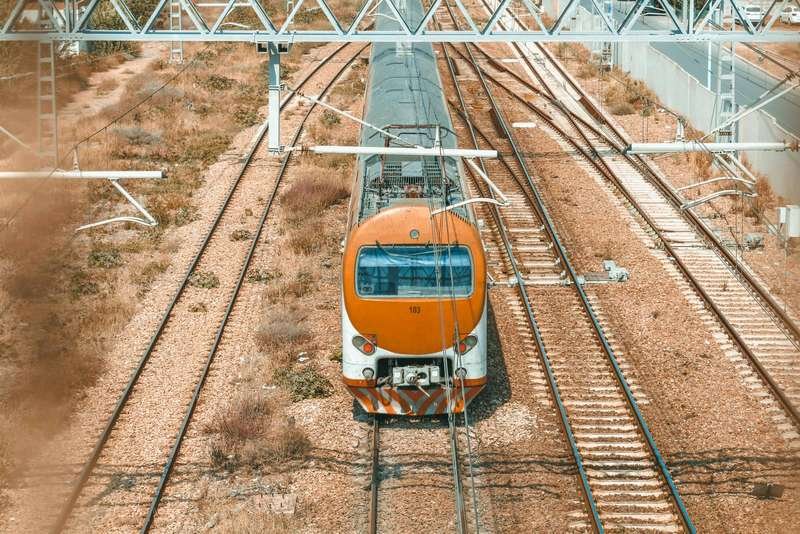
The high-speed Al Boraq service brings you from Tangier in about an hour and twenty minutes and from Casablanca in under an hour. Conventional trains connect Fes in roughly two and a half hours and Marrakech in about four.
The station detail matters more than people expect. Al Boraq calls at Rabat Agdal, which sits a few kilometres out in a newer district. Conventional services also call at Rabat Ville on Avenue Mohammed V, which is a short walk from the medina and the monuments. If your hotel is in the old city, the slower train that stops in the centre often gets you to your room sooner than the fast one that does not.
Rabat-Salé airport handles a modest number of international routes. Most travellers arrive through Casablanca instead, an hour and a quarter away by road in normal traffic, or a little under two hours by train with a change at Casa Voyageurs.
In the city, the tram is the useful surprise: two lines, roughly 27 kilometres, running along both banks of the Bouregreg and linking Rabat with Salé cleanly and cheaply. Petits taxis cover the rest; ask for the meter. The historic core, from the Kasbah to the Hassan esplanade to the medina, is walkable in flat shoes.
When to Go
Rabat's Atlantic Advantage
The ocean is the whole story. Rabat's summer highs sit in the mid-to-high twenties Celsius while Marrakech is pushing the high thirties, which makes the capital one of the few comfortable Moroccan cities in July and August. Mornings can start grey with sea fog that burns off by mid-morning.
Winter is mild but wet. Rain falls mainly between November and March, days stay around 17-18°C, and evenings need a jacket. Spring and early autumn give you the best of it: clear light, warm days, low humidity.
For how Rabat's season compares with the mountains, the coast and the desert, see our guide to timing a Morocco trip. Two local notes: French is far more useful than English here, more so than in Marrakech, and many businesses pause around Friday midday prayers.
Who Should Give Rabat a Day
It suits you if you are returning to Morocco and have already done the headline cities. If you are travelling in high summer and want somewhere the heat is bearable. If you are arriving or departing through Casablanca and would rather spend the night somewhere with monuments than in an airport hotel. If you travel with people who find souk pressure exhausting, which makes it a soft landing on a family journey. If museums, gardens and archaeology interest you more than shopping.
It does not suit you if this is your first Morocco trip and you have a week. If you came for the souks. If you want a city that overwhelms you. Rabat is competent and civilised, and competent and civilised is not what most people fly here for.
How Rabat Fits Into a Longer Trip
One night, occasionally two. The natural placement is on the north-south axis: a stop between Tangier and Fes, or between Chefchaouen and Casablanca, where breaking the journey costs you almost nothing and gains you an imperial city. Rabat also works as a first or last night for anyone flying through Casablanca, since the transfer is short and the city is more rewarding than the airport's surroundings.
Meknes and the Roman ruins at Volubilis lie a couple of hours east and make a full day out, though most travellers reach them more sensibly from Fes. If you have only a few days in the country, our short stays concentrate on one city rather than spreading you thin, and Rabat is rarely the one to choose. Where it earns its keep is on a longer cultural journey, where the four imperial capitals start to make sense as a set.
Quick Rabat Reference
Remember
Two things are easier to plan around than to discover on the day: the national museums close one day a week, and many businesses pause around Friday midday prayers. Check the museum day before you fix the sightseeing day.
If you would like Rabat built into a longer route, or an opinion on whether it belongs in yours at all, tell us what you are planning and we will give you one either way.
Frequently Asked Questions
- How many days do you need in Rabat?
One full day covers the Kasbah of the Udayas, the Hassan Tower and the Mausoleum of Mohammed V, and the medina. Two days lets you add Chellah, one of the museums, and Salé across the river without rushing. Rabat rarely justifies a third day unless you are here for a specific interest such as archaeology, modern art or golf.
- Is Rabat worth visiting?
It depends on your trip. On a first visit of a week or less, Marrakech and Fes give you more. Rabat earns its place on longer trips, on return visits, on journeys along the Atlantic coast, and for travellers who want walkable imperial monuments without souk pressure or summer heat. It is a pleasant, unhurried city, and that is the point.
- What is the best area to stay in Rabat?
Souissi, the leafy diplomatic quarter, is quiet and green with the city centre ten minutes away by car. The Hassan district puts you within walking distance of the monuments and the medina. The Bouregreg marina between Rabat and Salé is the newest option, with waterfront views. Hay Riad is a modern administrative district that is practical but has little atmosphere.
- How do you get from Casablanca airport to Rabat?
A train runs from the station beneath the airport terminal, with a change at Casa Voyageurs onto a northbound service. Allow a little under two hours in total. A private transfer takes roughly an hour and a quarter in normal traffic and is worth it after a long flight or with luggage.
- Is Rabat better than Marrakech?
They are not competing for the same traveller. Marrakech is intense, commercial and endlessly stimulating. Rabat is calm, orderly and administrative. If you want atmosphere, souks and energy, choose Marrakech. If you want monuments, museums, gardens and Atlantic air with almost nobody trying to sell you anything, Rabat does that better than any other Moroccan city.