Casablanca City Guide: The Mosque, Art Deco, One Night
Most visitors see Casablanca through a car window, on the way from the airport to somewhere else. That is a defensible decision. It is also, for a particular kind of traveler, the wrong one.
Anyone arriving in search of a smaller Marrakech or a modern Fes will be disappointed: no great medieval medina, no circuit of palaces, no mountains an hour out of town. Casablanca is a working city of just over three million people with one building that justifies a detour on its own, and a downtown holding one of the densest concentrations of 1920s and 1930s architecture in Africa. Whether that earns a place on your itinerary depends entirely on what you enjoy looking at.
Casablanca At a Glance
Casablanca is where most international flights land, which makes it the opening chapter of a great many Morocco trips. If yours is still taking shape, our first-time visitor guide covers arrival and how the regions fit together, and the transportation guide has realistic journey times between cities.
Morocco's Commercial Capital
Casablanca is Morocco's commercial capital and its largest port. The centre you walk through was laid out in the early twentieth century under the French Protectorate, on a plan drawn by Henri Prost, and built in a hybrid of Art Deco and Mauresque that exists almost nowhere else at this scale. European proportions, Moroccan ornament: horseshoe arches on apartment blocks, zellij panels beside steel casement windows, geometric plasterwork above a bank entrance.
The city does not perform for visitors, and this is the whole of its character. Nobody follows you down a street offering to take you to a tannery. The people around you are going to work, and after a few days in the tourist cities that indifference is a relief.
The trade-off is that Casablanca hands you very little unprompted. In Fes or Marrakech the atmosphere arrives whether or not you did any reading; here you need to know what you are looking at, or you will conclude there is nothing to see.
If you are choosing one historic city for a short trip, our Fes and Marrakech comparison is the more useful decision. Casablanca is not competing in that category.
The Hassan II Mosque
This is the reason to stop, and it would be a reason even if the rest of the city were empty.
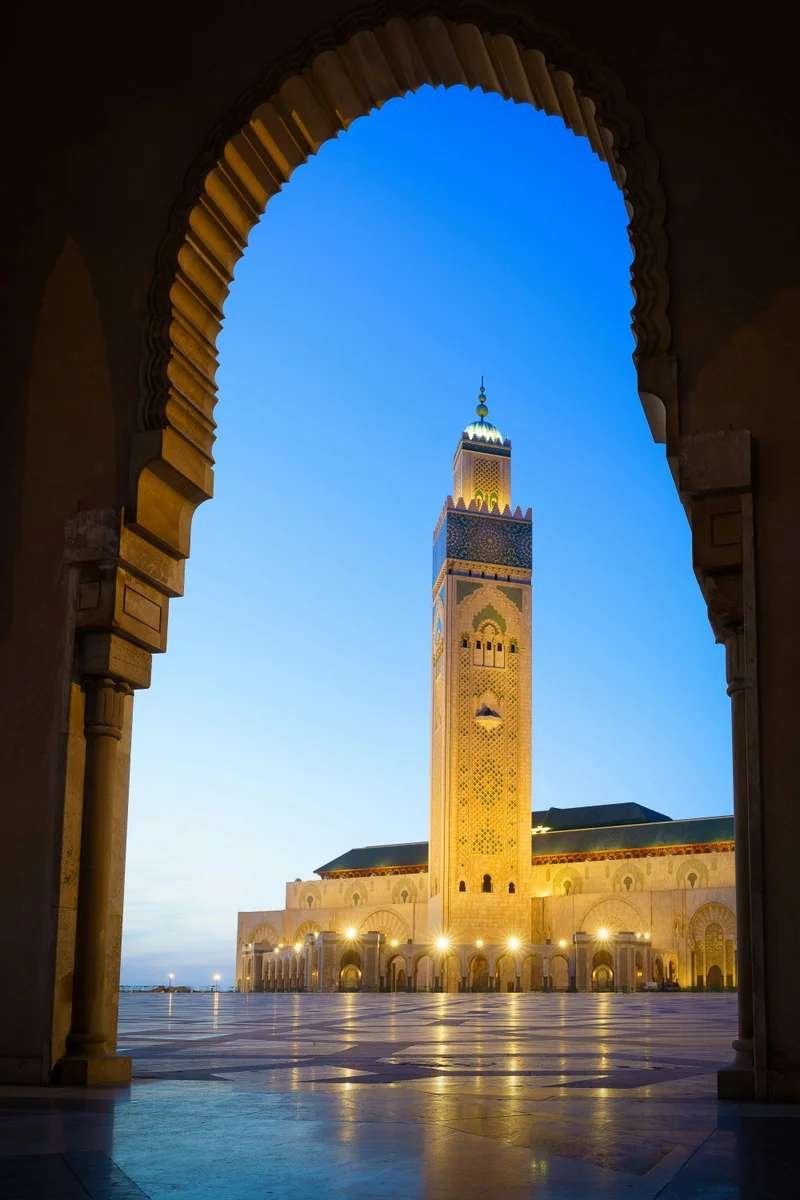
Inaugurated on 30 August 1993, the mosque stands partly on land and partly over the water, so that the Atlantic breaks against the sea wall below the prayer floor. The minaret rises 210 meters, which made it the tallest in the world until the Grand Mosque of Algiers took the title. The prayer hall holds 25,000 people and the esplanade another 80,000. The roof retracts: 1,100 tonnes that open in about five minutes so the congregation can pray under open sky.
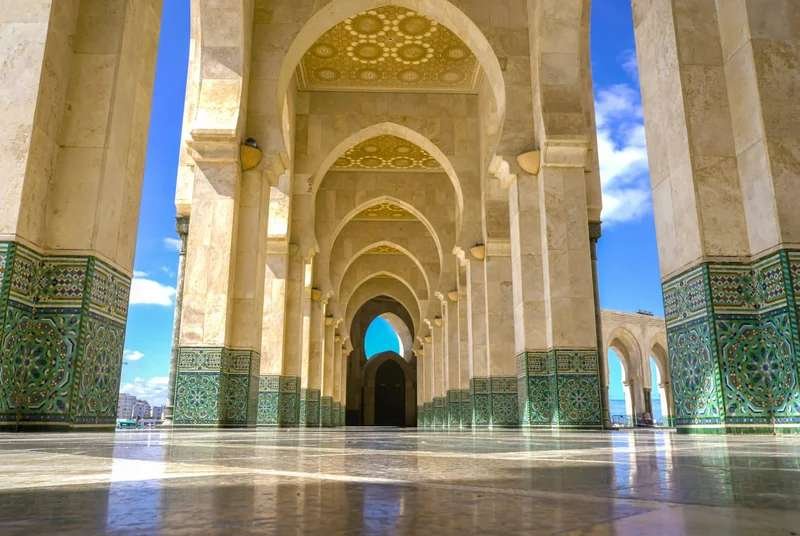
Scale is the easy part to convey and the least interesting. What holds you is the craftsmanship: carved cedar ceilings, marble and granite, zellij across acres of wall, doors cast in titanium, all of it executed by Moroccan artisans in the traditional trades. It is the largest commission those trades have received in modern times, and the best argument anywhere that they are still alive.
Visiting the Hassan II Mosque
This is one of the very few working mosques in Morocco that admits non-Muslim visitors, and only on a ticketed guided visit scheduled around the five daily prayers. Slots run through the morning and again in the afternoon, with fewer on Fridays. Tickets are bought at the visitor entrance beside the mosque; the tour lasts around an hour and usually includes the ablution hall beneath the prayer floor.
Shoulders and knees covered, shoes removed before the prayer hall. Hair covering is not required and scarves are not lent, so bring your own if you want one. Our packing guide has the detail.
Go in the morning. The light comes off the water, the groups are smaller, and you can stand on the esplanade afterwards without being hurried along.
Downtown: The Architecture Nobody Photographs
Start at Place Mohammed V, where the Protectorate-era civic buildings face each other across the square, and walk out along Boulevard Mohammed V. The Marché Central is a working produce and fish market inside a 1917 arcade; the stalls at the back will grill what you choose and serve it at a plastic table. The Rialto, a cinema from the 1930s, still shows films. The former Sacré-Coeur church, deconsecrated after independence, stands empty and white and hosts exhibitions.
Two museums are worth the detour. The Abderrahman Slaoui Foundation occupies a 1940s villa and shows one collector's Moroccan decorative arts: gold jewelry, Amazigh silver, crystal flasks and a wall of Orientalist travel posters that says a good deal about how Morocco was once sold to Europe. The Villa des Arts, in a 1934 house, shows contemporary Moroccan work.
The caveat is condition. Much of this downtown is in poor repair: shopfronts cut into elegant ground floors, cabling run across facades, some of the best buildings shuttered. If you like architecture you will find it moving. If you want heritage restored and presented for you, it is a shabby couple of hours.
Habous and the Old Medina
The Habous quarter, sometimes called the new medina, was built from the 1910s onward as a planned Moroccan neighborhood: arcaded lanes, orderly blocks, a designed medina rather than an organic one. It works better than that suggests. Pastry shops, olive and preserved-lemon stalls, a long-standing cluster of booksellers, jewelry workshops where nobody chases you down the street. The Mahkama du Pacha nearby is a mid-century courthouse full of carved cedar and zellij, though opening to visitors is irregular and worth checking on the day.
The old medina, down by the port, is rougher, lived-in and not scenic. It rewards a wander if you like unpolished cities and disappoints anyone expecting Fes.
Sequencing matters here. If Fes or Marrakech is on your itinerary, Casablanca's medinas will not add anything, and our guide to souks and medinas is better spent on those cities. If Casablanca is your only Moroccan city, Habous gives you a compact, low-pressure version in an hour.
The Corniche and Ain Diab
West of the mosque the coast road runs out to Ain Diab, a strip of beach clubs, pools and seafood restaurants where the city spends its weekends. The Atlantic here is cold in every month of the year and the sand is not the reason to come. Dinner facing the water is, and so is the walk back east at dusk with the mosque lit at the end of the bay.
For proper beach days the coast has better answers further south, which our Atlantic coast guide covers in full.
Where to Stay, by Area
Anfa and the corniche. Ocean, gardens and quiet, in the residential west of the city. The Four Seasons sits on the shore at Anfa Place with the Atlantic from the upper floors. The trade-off: everything downtown is a taxi ride, and the traffic makes it unpredictable.
The centre, around Sidi Belyout and Place des Nations Unies. The most useful base if you want to walk. The old medina, the Art Deco boulevards, the Marché Central and Casa-Port station are all on foot from here, and the mosque is a short drive. The Hyatt Regency and the Sofitel Tour Blanche both sit in this district. It is noisy, so ask for a high floor away from the boulevard.
Downtown boutique. Hôtel Le Doge, a Relais et Châteaux in a 1930s townhouse, has sixteen rooms and the feel of a private house: character and a small staff rather than a spa and four restaurants. The Royal Mansour collection's Casablanca property reopened in 2024 after a long restoration, with a rooftop looking across the city towards the mosque.
Ain Diab. Best if the beach clubs and seafood are the point. Furthest from the centre.
Choosing Between Them
Decide by how you intend to spend your evenings. If you want to walk out of the lobby and be among the buildings, stay in the centre and accept the noise. If you want the day to end quietly with the ocean in front of you, stay in Anfa or Ain Diab and budget for taxis.
Ask specifically about the view when booking. In Casablanca the difference between a room facing the water and one facing an internal courtyard is the difference between two entirely different stays, and it is rarely reflected in how the room is described.
Getting There and Around
By air. Mohammed V International, about 30 kilometers southeast of the city, is Morocco's main hub and takes the widest range of long-haul and Gulf routes.
From the airport. A train station sits directly beneath the terminal, with services roughly hourly from early morning to late evening, reaching Casa-Voyageurs in around thirty minutes and continuing to Casa-Port. By road the same journey is forty-five minutes to an hour, considerably longer at rush hour.
By train. Casablanca is the southern terminus of the Al Boraq high-speed line: Tangier in 2h10 and Rabat in under an hour, roughly hourly. Marrakech is two and a half to three hours on the conventional line. Casa-Voyageurs is the main station; Casa-Port is closer to downtown. The transportation guide sets out the full network and the trade-offs against driving.
Around the city. Red petit taxis are everywhere and should run the meter; ask for it. Four tram lines cross the city on one flat fare with transfers valid for two hours, useful along the downtown-to-corniche axis. Walking works within the centre and nowhere else.
Allow For the Traffic
Traffic is the practical constraint on a Casablanca day. Journeys that look like fifteen minutes become forty in the morning and evening peaks. Two sights on opposite sides of the city will cost you more of the day than you expect.
Plan around it: the mosque and the corniche in one half of the day, downtown and Habous in the other. Crossing back and forth is what eats the afternoon.
Worth a Day Out
El Jadida lies about 90 to 100 kilometers southwest, an hour and a half by road. The Portuguese built the fortified town of Mazagan here in the sixteenth century, and the walled quarter is a UNESCO World Heritage Site. The cistern beneath it, a low vaulted chamber with a film of water reflecting the columns, is one of the strangest interiors in Morocco. The Church of the Assumption alongside it is late Gothic Manueline, which you do not expect on this coast. Seafood by the harbor finishes the day.
Rabat is under an hour by high-speed train, which makes the capital a straightforward day out, or an easy overnight if you would rather split the city time.
Stop in Casablanca, or Fly Through
Stop if you respond to architecture and want a Morocco that is not curated for visitors. Stop if you care about food, since the restaurants range well beyond Moroccan cooking and the fish is landed on the doorstep. It is also the obvious choice for repeat visitors who have done the imperial cities, and for anyone who would sooner spend a travel night in a real city than in an airport hotel.
Fly through if this is your first Morocco trip and you have a week. The classic circuit will give you more, and Casablanca is best treated as the airport it also happens to be. The same goes for travelers who came for souks, riads and courtyards, or for the film, which was shot on a studio lot in California and bears no relation to the place.
How Long to Give It
Half a day covers the mosque and lunch, and works neatly around a flight. A full day adds downtown and Habous without hurrying. Two nights are worth it if you want the restaurants, an evening on the corniche and a day out to El Jadida.
For most itineraries one night, on arrival or before departure, is the right answer. If your trip is short, our short-stay journeys concentrate the time; if food is the draw, the culinary journeys treat Casablanca's markets and its landed fish as a destination, not a stopover.
Quick Casablanca Reference
The One Fixed Point
Build the day around the mosque, not around lunch. Visit slots run through the morning and again in the afternoon, with fewer on Fridays, and it is the one thing in Casablanca you cannot improvise on the day.
Planning a Morocco itinerary that begins or ends in Casablanca? We structure the arrival and departure days so the city gives you something back for the night you spend in it.
Frequently Asked Questions
- Is Casablanca worth visiting?
Casablanca is worth a stop if you are interested in the Hassan II Mosque, early twentieth-century architecture, or contemporary Moroccan city life. It has no great medieval medina and does not compete with Fes or Marrakech on atmosphere. Many travelers give it half a day around a flight, and that is a sound way to use it.
- How many days do you need in Casablanca?
Half a day covers the Hassan II Mosque and lunch. One full day adds the Art Deco downtown and the Habous quarter. Two nights make sense if you want the restaurants, the corniche at Ain Diab, and a day trip to El Jadida. Most itineraries use one night, on arrival or before departure.
- Can non-Muslims visit the Hassan II Mosque?
Yes. The Hassan II Mosque is one of the very few working mosques in Morocco that admits non-Muslim visitors, on a ticketed guided visit scheduled around the five daily prayers, with fewer slots on Fridays. Shoulders and knees must be covered and shoes are removed before the prayer hall. Hair covering is not required and scarves are not lent, so bring your own if you want one.
- Where should you stay in Casablanca?
Anfa and the corniche give you ocean views, space, and quiet, at the cost of a taxi ride to everything downtown. The centre around Sidi Belyout and Place des Nations Unies puts the old medina, the Art Deco boulevards and Casa-Port station within walking distance, but it is noisy. Ain Diab suits travelers who want the beach clubs and seafood restaurants.
- How do you get from Casablanca airport to the city?
A train station sits beneath the terminal at Mohammed V International. Trains run roughly hourly to Casa-Voyageurs in about thirty minutes and continue to Casa-Port. By road the same trip takes forty-five minutes to an hour, and longer in rush-hour traffic, so allow more time when heading back out to a flight.