Fes City Guide: Where to Stay and How to See It Well
Fes is not a preserved old town with a city attached. It is a working medieval city that still runs on foot and on mule, where the craft quarters make things for the households that live around them and the university at its centre has taught since 859. Nothing here was arranged for visitors, which is the appeal and also why some people leave frustrated after a day and a half.
What follows is where to base yourself, what earns your time, and who should probably go somewhere else. If you are still choosing between Fes and Marrakech, we have answered that question at length in our comparison of the two cities. This piece assumes you are coming.
Fes At a Glance
Three Cities With One Name
Fes is three distinct places, and knowing which one you are in saves much confusion.
Fes el-Bali is the old medina, founded in the ninth century and now a UNESCO World Heritage Site. It is one of the largest car-free urban areas anywhere, which is a practical fact rather than a slogan: no vehicle enters, goods move by handcart and mule, and every arrival ends on foot.
Fes el-Jdid, the "new" Fes, is new only by the standards of a city this old; the Marinids laid it out in the thirteenth century. It holds the royal palace, whose brass gates on Place des Alaouites are worth a short stop, and the mellah, the historic Jewish quarter, whose taller façades and street-facing balconies look nothing like the blank walls of the old medina.
The Ville Nouvelle is the twentieth-century district: boulevards, cafés, ordinary shops, most of the city's conventional hotels, and the train station.
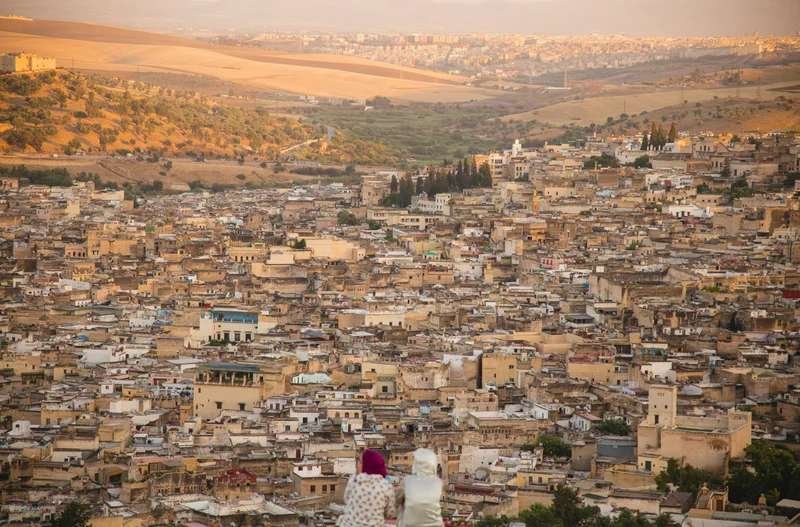
The medina lies in a bowl, the most useful orientation you can carry. Enter through the upper gates and the main lanes run downhill toward the Qarawiyyin quarter at the bottom. Walk down in the morning, take a taxi back around the walls in the afternoon, and the climbing is done for you.
Where to Stay
The best accommodation in Fes is inside the medina, in restored riads and palace houses. That is less a matter of taste than of supply: the city's finest buildings are old courtyard houses, and the people who restored them turned them into places to stay.
Riad Fès, a fourteenth-century palace now part of Relais & Châteaux, is the usual benchmark, with a spa, a serious kitchen and a rooftop over the whole medina. Below it sits a deep field of smaller houses, several with only a handful of rooms, which is why they sell out early in spring and autumn. Our notes on how riads work and how we judge a property cover what separates a good one from a photogenic one.
Three trade-offs before you book inside the walls:
Nothing drives to your door. Your car stops at a gate and someone meets you with a cart for the luggage. That last stretch may be two minutes or ten, over uneven paving and occasional steps.
Old houses are cold in winter. Thick walls, open courtyards, often no central heating. Between December and February this matters more than people expect.
Small houses have small services. A house of a dozen rooms cannot support a gym, a large pool or a late kitchen. In exchange, someone knows your name by the second day.
Medina Edge as the Compromise
Several of the larger palace hotels sit on the medina's outer rim instead of deep inside it. You keep the courtyards, the craftsmanship and the rooftop views, but the walk from the vehicle is short and the drive to the Ville Nouvelle or the airport is straightforward. For travellers with mobility concerns, or anyone arriving late, this is usually the sensible choice.
If medina logistics sound like more than you want to manage, the Ville Nouvelle has conventional hotels with lifts and parking. You lose the atmosphere entirely, which for a two-night stay may be a poor bargain.
What Earns Your Time
The First Morning, With a Guide
Hire a licensed guide for your first half-day and treat it as orientation; the sights can wait until the afternoon. Fes el-Bali defeats mapping applications: the lanes are narrow, the walls are high, the signal drops. A good guide gives you the shape of the place and how the main arteries connect, so the next day you can wander without anxiety.
Guides can be arranged by interest — craft workshops, Andalusian architecture, the food quarters, the mellah and Jewish heritage — and a focused walk is worth far more than a general one. This is what our culture-focused journeys are built around.
The Madrasas
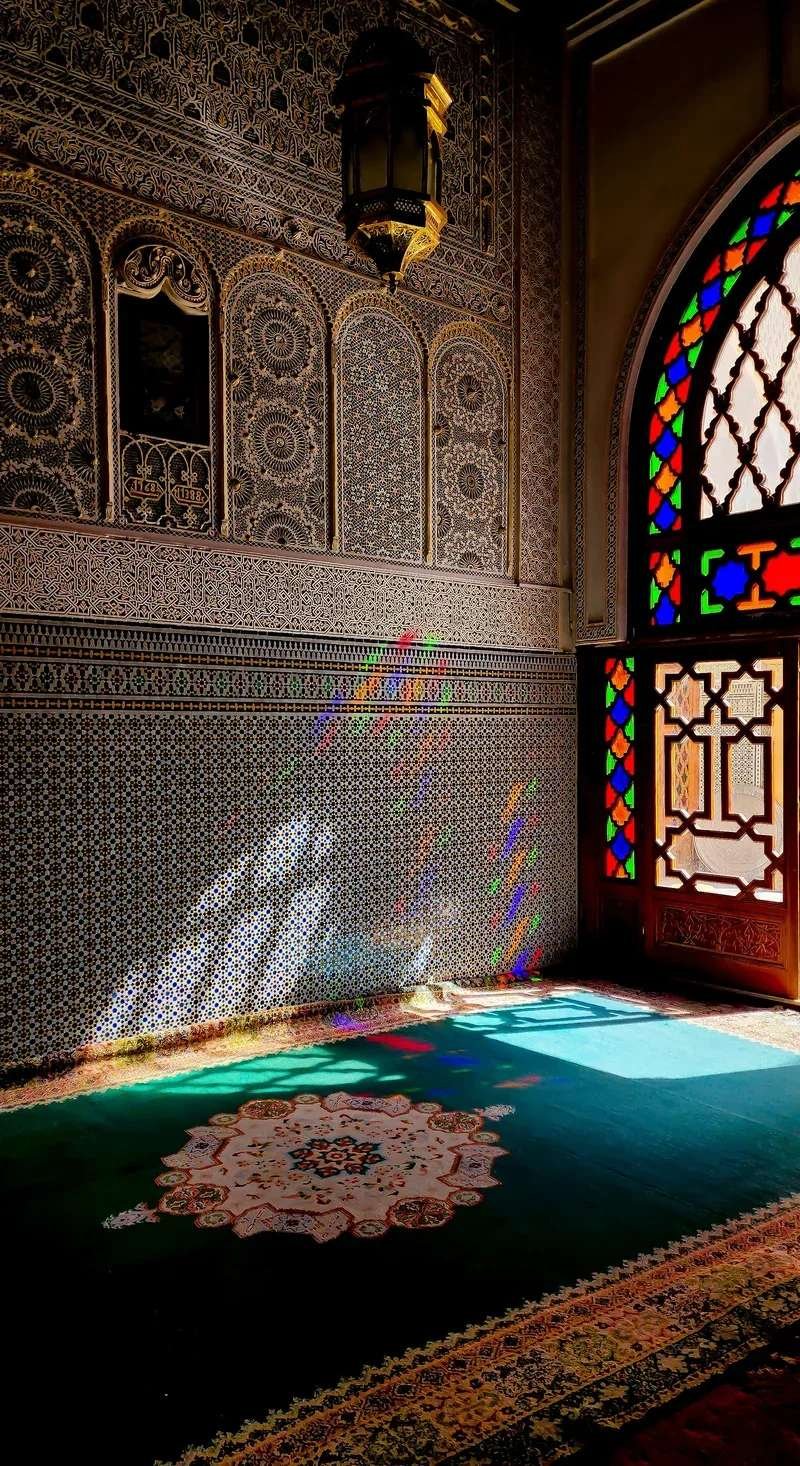
The Bou Inania madrasa, built in the middle of the fourteenth century, is the one to see if you see only one, and among the few functioning religious buildings in Morocco open to non-Muslim visitors, though it closes around prayer times and on Fridays. The al-Attarine madrasa, a short walk away in the spice merchants' quarter, is smaller and, to many eyes, finer still: carved cedar, chiselled stucco and zellige worked at a level that repays standing still.
Al-Qarawiyyin
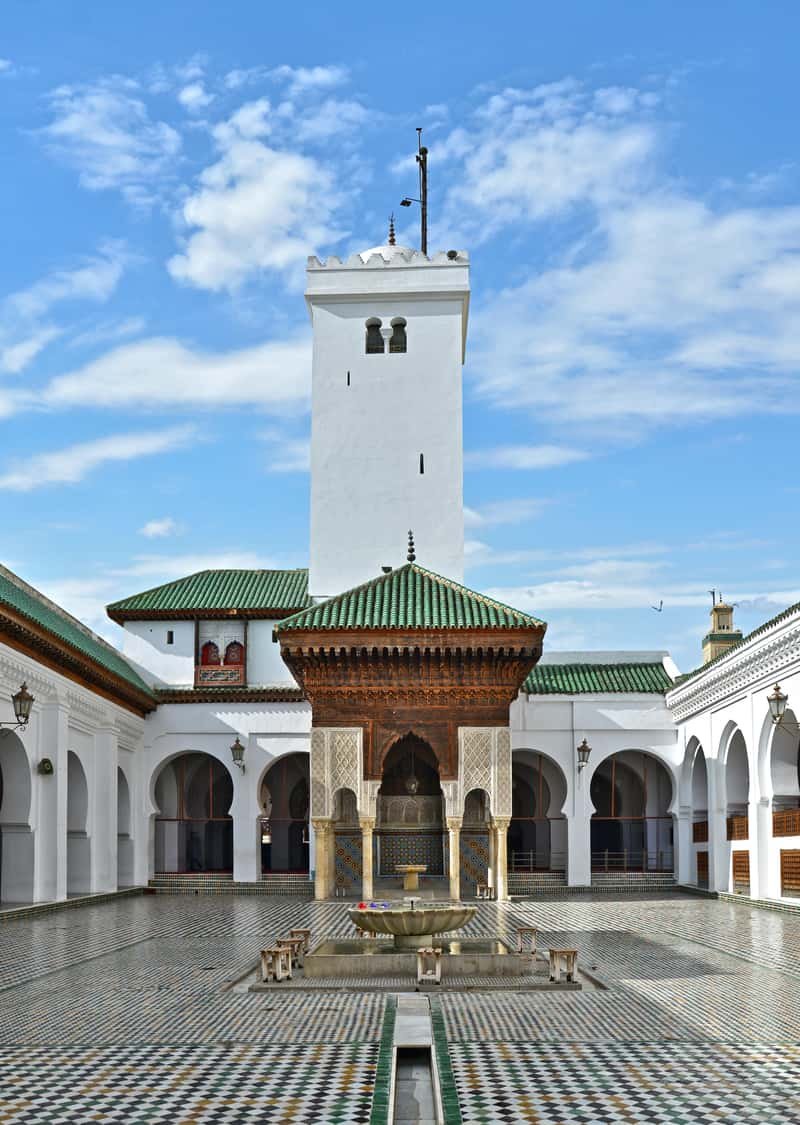
Founded in 859 by Fatima al-Fihri and recognised as the oldest continuously operating university in the world, al-Qarawiyyin is why Fes calls itself Morocco's intellectual capital. The prayer hall is closed to non-Muslims, but doorways along the surrounding lanes give onto the courtyard, and that view of green-tiled roofs and the cedar pavilion over the fountain is the image at the top of this page. Muslim visitors may pray there, and many Gulf travellers tell us it was the moment of the trip.
The Chouara Tannery
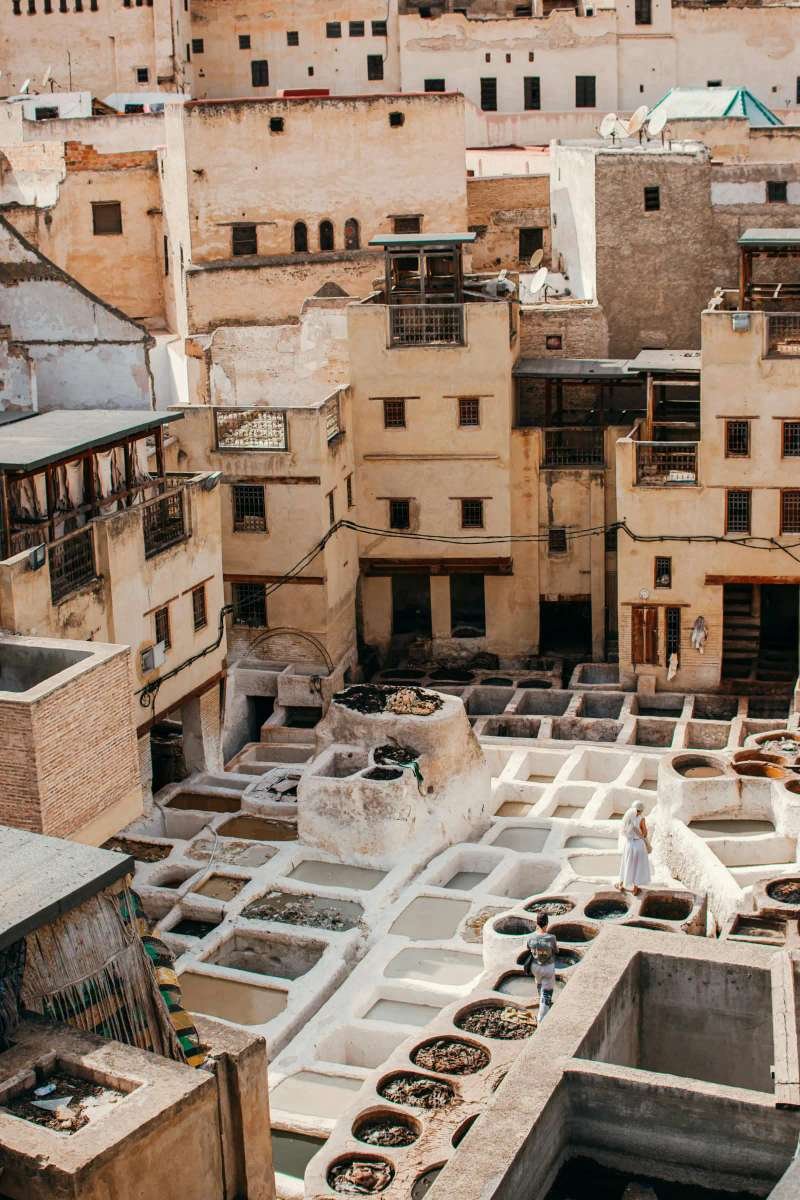
Still working, still using the same pits and the same methods. You look down from the terraces of the leather shops that ring the site, and they grant access on the understanding that you will look at their stock on the way out. The smell is strong; the sprig of mint handed to you at the door helps less than you would hope. Go anyway. Nowhere else in Morocco is a medieval industry this visible from above.
Al Batha, and an Hour Indoors
The Al Batha museum of Islamic arts reopened in 2025 after a long restoration, in a nineteenth-century palace with an Andalusian garden. It holds Fassi ceramics, woodwork, embroidery and manuscripts, labelled in Arabic, French and English. An hour here early makes the souk workshops legible: you learn what good work looks like before anyone tries to sell you any.
The View at the End of the Day
Climb to the Marinid tombs north of the walls in the last hour of daylight. The medina lies below in its bowl, the call to prayer rises from several directions at once, and the light turns the rooftops the colour of the walls. It costs nothing and is the best half-hour in Fes.
Cooking, and the Food Question
Fassi cooking is widely held to be Morocco's most refined, drawing on Arab, Amazigh, Andalusian and Jewish traditions. Pastilla, rfissa and tagines with preserved lemon are the benchmarks, and the medina houses do them better than restaurants built for visitors. A class in a riad kitchen, preceded by shopping in the souk, is the best half-day here for anyone who cares about food; our guide to cooking classes explains what separates a real one from a demonstration, and our culinary journeys are built around it.
Restaurants are fewer and more traditional than in Marrakech. Your riad's own table is the reliable choice, worth booking in the morning and not at eight in the evening.
Day Trips Worth the Drive
Meknes and Volubilis. Meknes is an hour west and the calmest of the imperial cities: the vast Bab Mansour gate, Moulay Ismail's monumental granaries and stables, a medina you can cross without getting lost. Volubilis, the best-preserved Roman site in Morocco, lies beyond it with its mosaics still in the floors they were laid in, and the hilltop town of Moulay Idriss sits between the two. All three make one full day, not an afternoon.
The Middle Atlas. South of the city the land climbs into cedar forest around Ifrane and Azrou, where the air is cool and the Barbary macaques are wild. A half-day, and welcome relief in high summer.
Chefchaouen. The blue town in the Rif is the most requested trip from Fes and the one we most often talk people out of. It is far enough north that a day trip means most of the day in a vehicle for two hours in the town. As an overnight on the way to Tangier it is a pleasure; as a day trip it is a long drive to take a photograph.
Getting There and Getting Around
Fes sits on the classic rail line rather than the high-speed one. Trains run from Casablanca in just under four hours and from Rabat in under three, roughly hourly. From Tangier the quickest routing takes the high-speed train to Kenitra and changes there; the direct classic service takes a little over four hours. First class is a modest supplement and worth it. For how trains, buses, private drivers and hire cars compare, see our guide to getting around Morocco.
Fès-Saïss airport handles mostly European routes, many seasonal and flown by low-cost carriers. Travellers from the Gulf should plan on connecting through Casablanca unless a direct service happens to suit their dates.
Inside the medina you walk; there is no alternative. Between the gates, the Ville Nouvelle and the station, small city taxis are cheap and plentiful; ask for the meter. Keep your riad's card in your pocket: shown to a shopkeeper, it produces directions and often an escort, more reliably than any map.
When to Come
March to May and September to November are the two good windows: warm days, cool evenings, and the medina at a workable temperature for walking six hours. Summer is hot inland, with July and August highs commonly in the low to mid thirties Celsius and occasional days above forty. Winter days are mild but the nights are cold and most of the year's rain falls then, so pack layers for old houses with thick walls and no central heating.
Late spring also brings the Fes Festival of World Sacred Music, which fills the good riads months ahead. If your dates fall near it, book early or move them.
Who Fes Rewards, and Who It Wears Out
It rewards travellers who like being slightly off-balance; anyone drawn to craft, architecture or food; second-time visitors who found Marrakech too smooth; and people happy to spend a day without a fixed plan. It asks for patience more than energy.
Fes is harder on travellers with limited mobility, because the medina is stepped, steep in places and closed to vehicles; families with small children, for the same reasons and because the dining is less accommodating; anyone whose holiday depends on a pool; and anyone with only twenty-four hours, who will spend most of it disoriented.
Anyone who wants to watch a thousand-year-old city go about its ordinary business will not find a better one in Morocco.
How We Would Structure It
Two nights is thin but workable: a guided morning, the madrasas and the tannery on day one; a slower second day for the museum, the craft quarters and the hillside at dusk. Three nights adds a cooking class without hurrying; four takes in Meknes and Volubilis. Fes tends to work better at the end of a longer route than at the start, and it slots into shorter focused trips more easily than people expect.
We arrange the guides, the riad, the transfers and the day trips, and we say so when a city is the wrong fit for a particular traveller. Tell us what you have in mind and we will tell you whether Fes belongs in your itinerary, and how many nights it needs.
Fes Quick Reference
One Thing to Accept
You will get lost. Everyone does, including people who have visited many times. It is the price of admission, not a failure of planning: keep your riad's card on you, and allow an extra half-hour before anything that has a fixed time.
Frequently Asked Questions
- How many days do you need in Fes?
Two full days is the minimum that makes the journey worthwhile, and three is more comfortable. Two days covers a guided morning in the medina, the madrasas, the tanneries and one unhurried afternoon of wandering. A third day allows a cooking class or the craft workshops. Add a fourth if you want the day trip to Meknes and the Roman site at Volubilis, which needs a full day, not an afternoon.
- Where should you stay in Fes?
Most travellers stay in a restored riad or palace house inside Fes el-Bali, the old medina, because that is where the character is. The trade-off is logistics: no vehicle reaches the door, so you arrive at a gate and walk the last stretch with a porter. Properties on the medina's edge keep the atmosphere while shortening that walk. The Ville Nouvelle, the twentieth-century district a short drive away, offers conventional hotels with parking and lifts, at the cost of atmosphere.
- Do you need a guide in Fes?
For the first morning, yes. Fes el-Bali is a genuine labyrinth where mapping applications lose their bearings between high walls, and a licensed guide turns a stressful walk into a legible one. After that first orientation, most people are content to wander alone. Licensed guides carry official identification. The men who approach you in the street offering to help are usually working on commission from the shops they steer you toward.
- What is the best time of year to visit Fes?
March to May and September to November. Fes sits inland at around 410 metres, so it runs hotter than the coast in summer, with July and August highs commonly in the low to mid thirties Celsius and occasional days above forty. Winter days are mild, the nights drop sharply, and most of the year's rain falls then. Old riads have thick walls and often no central heating, so pack layers for a winter stay.
- Is the Chouara tannery worth visiting?
Yes, provided you know what you are walking into. It is a working tannery and not a demonstration laid on for visitors, so the smell is strong and unavoidable. Viewing is from the terraces of the leather shops that surround the pits, and those shops let you up in the expectation that you will at least look at their goods afterwards. There is no obligation to buy, but if you want a photograph without any commercial conversation, this is not that kind of place.