Planning Your Morocco Trip: What Takes Real Work
You've decided on Morocco. Perhaps you're extending a European itinerary by a few days, or the country has climbed steadily toward the top of your travel list. Either way, you now face the same question: plan it yourself, or work with someone who already knows the country.
This piece isn't designed to frighten you into booking with anyone. Morocco is navigable on your own, and thousands of travelers manage it every year. What follows is what the work involves and where the friction sits.
The goal is simple: help you make a choice you won't second-guess from a riad rooftop three days into your trip.
Planning at a Glance
The Easy Parts
Start with the good news, because there's plenty of it. A good deal of Morocco travel needs no expertise at all to arrange.
Flights present few complications. Royal Air Maroc, Ryanair and several European carriers serve Marrakech and Casablanca with regular frequency; Fes has fewer direct routes but is reasonably well connected. Booking works exactly as it does anywhere else.
Visas are a non-issue for most Western travelers. Americans, Europeans, Canadians, and citizens of many other countries receive visa-free entry for stays up to 90 days. Your passport needs to be valid for more than 90 days beyond the date you arrive. That's the extent of it.
Currency and payments function predictably. ATMs exist throughout cities and major towns, dispensing dirhams at reasonable exchange rates, and credit cards work at established hotels and restaurants. Cash remains essential for souks, smaller establishments and rural areas, which is true of most countries outside Northern Europe. Carry more of it than you think you need.
Language proves more navigable than most travelers anticipate. French opens doors throughout the country, a legacy of the protectorate period. English functions reasonably well in Marrakech, Fes, Essaouira, and other tourist centers. In rural areas and smaller cities, communication requires more creativity, but translation apps handle the gaps passably. You will be understood. You will understand enough.
If these logistics represented the full picture, there would be little reason to seek outside help. They don't.
Where the Real Planning Begins
The complexity of Morocco travel lives in the details that don't appear on booking platforms. They are what separates an adequate trip from a very good one.
How Long Does It Take to Drive Across Morocco?
Morocco's distances deceive even experienced travelers. Maps suggest reasonable drives between major destinations. Reality involves winding mountain roads that switchback through passes, single-lane stretches through villages where children play and livestock wanders, and travel times that routinely double what Google predicts under ideal conditions.
Consider the route from Marrakech to Fes, where the delays have nothing to do with mountains. Your navigation app displays approximately five hours for the 530 kilometres of motorway running north through Casablanca and Rabat, a figure that assumes an unbroken run at speed. In practice, tolls, fuel stops, the slow crawl through Casablanca's approaches and a proper lunch put the day closer to seven hours. Longer still if you turn off near Meknes for Volubilis and Moulay Idriss, which most travelers find they want to do.
The Sahara presents an even starker example. From Marrakech, reaching the dunes at Merzouga or M'Hamid requires crossing the High Atlas, descending through the Draa Valley or the Rose Valley, passing through Ouarzazate (itself worth a half-day), and continuing southeast across increasingly arid terrain. This journey covers roughly 350 kilometres and consumes an entire day of travel in each direction. There is no way to compress it that does not cost you the landscape changing under the car.
Realistic Morocco Drive Times
Marrakech to Fes: 7 hours (not 5)
Marrakech to Merzouga (Sahara): 8-9 hours
Fes to Chefchaouen: 4 hours
Marrakech to Essaouira: 2.5-3 hours
Casablanca to Marrakech: 2.5 hours
These estimates assume direct driving without stops. Add 1-2 hours for meals, photos, and unexpected delays.
What this means practically: itineraries that look elegant on paper often prove exhausting in execution. The traveler who plans to "see Marrakech, visit the desert, explore Fes, and relax in Essaouira" in eight days will spend more time in vehicles than in any single destination, arrive everywhere tired, and remember the transfers more clearly than the places.
A route that makes geographic sense on a limited number of days takes more than distances. It takes knowing the road surface, the season, and how long the drive really is from the snow line to the date palms.
How Do I Choose a Riad in Morocco?
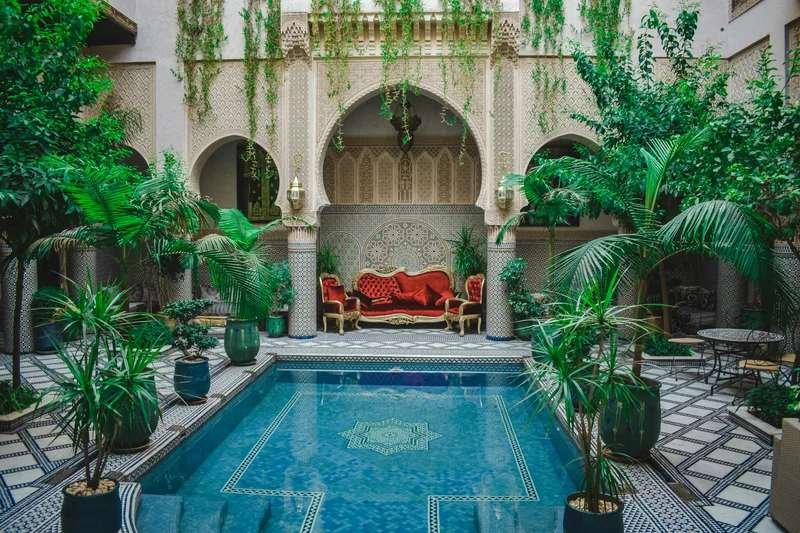
Morocco's riad culture has no close equivalent elsewhere. These restored courtyard houses, many of them centuries old, have been turned into small guesthouses down medina alleys no vehicle can enter. A well-chosen one means a room off a courtyard with a fountain and an orange tree, the call to prayer at dawn, and breakfast on a roof looking out across a sea of satellite dishes and minarets.
Finding these properties online is straightforward. TripAdvisor, Booking.com, and various aggregators list hundreds of options in Marrakech alone, thousands across the country. The challenge lies elsewhere: the gap between what a listing promises and what you get varies more in Morocco than almost anywhere else.
Some riads photograph extraordinarily well and are run by absentee foreign owners through staff for whom it is simply a job. Others maintain stunning central courtyards but position paying guests in rooms facing the street, where noise from the medina penetrates until well past midnight. A troubling number rank highly on platforms because they've mastered the mechanics of soliciting reviews from every guest who crosses the threshold, regardless of whether the experience justified such enthusiasm.
What Distinguishes Exceptional Riads
Owner presence or invested management — Staff who care beyond their shift
Room positioning — Courtyard-facing rooms on upper floors beat street-facing
Breakfast quality — Usually the truest signal of overall standards
Staff continuity — The same faces month after month, not scripted hospitality
Authentic restoration — Real craftsmanship, not decorative staging
Relationships with local guides — Connected properties open more doors
The riads worth staying in often don't appear at the top of search results. They fill their rooms through reputation and through partners they trust to send the right guests, so they have never needed to optimize for an algorithm. A small house does not need many bookings; it needs the right ones.
This pattern repeats across accommodation types. Desert camps range from magical to miserable, and photographs reveal almost nothing about which you're booking. Mountain lodges vary from authentic Berber hospitality to theme-park approximations designed for tourists who want the aesthetic without the substance. Coastal guesthouses present the same spectrum.
Is It Easy to Navigate Moroccan Medinas?
This is where Morocco stops resembling European travel.
The medinas of Marrakech, Fes, Meknes, and other historic cities are not neighborhoods in any conventional sense. They are labyrinths. The word is not metaphorical. Thousands of alleyways connect and diverge according to logic that predates modern urban planning by centuries. Streets narrow to the width of outstretched arms. Passages that appear to lead somewhere terminate without warning. GPS, dependent on satellite signals that struggle to penetrate the dense construction, provides guidance that ranges from imprecise to actively misleading.
You will get lost. Plan for it as a certainty, not a risk. Whether that ends in a tile workshop you would never have found, or in a dinner reservation you waited weeks for and missed, depends mostly on how much slack you left in the day.
The experienced traveler navigates by landmark, not compass direction: the quality of the light, the density of foot traffic, the fact that the tanneries smell one way and the spice souk another. That knowledge accumulates through exposure. It cannot be downloaded in advance.
Outside the medinas, navigation presents different but related challenges. Moroccan roads vary considerably in quality and marking. Signage sometimes appears in Arabic alone, sometimes in French, occasionally in both, and the conventions differ between regions. Traffic in cities follows patterns that reward local knowledge over formal rules. The driving itself isn't dangerous for attentive travelers, but it demands the kind of focus that pulls attention away from the landscape you came to see.
Many visitors who planned to rent a car and drive themselves give it up after a day or two. The attention that navigation demands is the same attention you came to spend on the landscape.
Can I Book Authentic Experiences Online?
Morocco's best experiences require a telephone call.
The cooking class with a family in Fes who have prepared the same recipes across four generations is not listed on any platform. The grandmother who teaches tagine technique doesn't maintain a website. Her daughter buys ingredients at the morning market based on who is expected that day. Arranging a session means knowing the family, sending your preferences ahead, and arriving at the right hour at a door in an alley you would never find twice.
The pottery workshop in Safi where a master craftsman shapes vessels using methods unchanged for centuries does not accept online reservations. He works when he works. He accepts visitors through people he has come to trust over years of relationship. His workshop is not marked on Google Maps.
The lunch at a mountainside home overlooking terraced olive groves, where a Berber family serves dishes that appear in no restaurant, requires an introduction. Someone has to know the family, and to have earned that over repeated visits. Someone has to be able to make a telephone call and say: these are good people, they should come.
Experiences of this kind exist in every region of the country, and they are much of what makes it worth the trip. They are also, by their nature, invisible to anyone researching from a laptop.
Finding them independently isn't impossible. It takes either a long stay, a great deal of asking around, or the kind of fortunate coincidence that makes for good stories and unreliable planning.
The Hidden Costs of Planning Morocco Independently
Most people count only the direct expenses: agency fees, guide costs, the markup on a room booked through someone else.
The larger costs are less visible. They appear on no invoice, and they shape the trip as surely as any budget line.
Research Time Before Your Trip
Researching accommodation across several regions, reading reviews critically, cross-referencing platforms, separating the properties that deserve consideration from those whose ratings reflect marketing: fifteen hours, minimum, for a thoughtful week-long trip. Often considerably more.
Then the route. Realistic travel times, stops that turn a transfer into a day worth having, enough slack that one late start doesn't collapse the week: another ten hours.
Experiences are the open-ended part. Finding what exists beyond the standard circuit, checking whether an operator's claimed local expertise is real, then fitting the bookings around each other — it varies by trip, but it rarely comes to less than everything above.
Estimated Planning Time for a 7-Day Morocco Trip
Accommodation research: 10-15 hours
Route planning: 8-12 hours
Experience research and booking: 10-15 hours
Logistics coordination: 5-8 hours
Total: 33-50 hours
These hours have a value. Some people spend them happily, as part of the trip; others resent every one of them. Either way, they are not free.
Logistics During Your Trip
The hours spent on logistics continue after arrival. Navigation takes attention that would otherwise go to looking at things, and confirming arrangements, absorbing changes and explaining what you need across a language gap take the rest. None of it lands in one block; it distributes itself across the day.
The traveler who runs their own logistics spends a real part of each day solving problems and deciding what happens next. There are satisfactions in that. It is not the same state of mind as having nothing to do but look.
That matters more in Morocco than in many places. The medina rewards patience, the mountain roads reveal themselves slowly, and Moroccan hospitality only opens up in unhurried conversation. All of it needs a mind with room in it.
What You Won't Know You Missed
This may be the most significant cost and the hardest to perceive: the experiences that never occurred because you didn't know they were possible.
The photographer who books a standard desert camp may never learn that twenty minutes further on, a smaller camp faces the right way for sunrise. The couple looking for romance may choose a well-reviewed riad without knowing that three streets away there is a roof where they could have dined alone.
The family traveling with children may miss the village where kids spend an afternoon learning to press olive oil, because no platform lists it. The food enthusiast may never find the woman who makes the best msemen in the city, because her stall appears in no guide.
None of that is hypothetical. It is the ordinary gap between what surfaces in research and what exists on the ground. Every destination has one. In Morocco, where so much still runs on relationships and not on transactions, it is unusually wide.
Should I Use a Travel Agency for Morocco?
Some trips benefit disproportionately from local knowledge. Most do not, so it is worth being precise about which ones.
First visits to Morocco involve the steepest learning curve. The intuitions that make a trip feel fluid instead of effortful only come with exposure: how to read a medina, when to negotiate a price and when to pay it, which restaurants are cooking and which are feeding tour groups, which experiences are worth your limited days.
A good guide compresses that learning into a day or two. More usefully, they spare you the early mistakes you would otherwise learn from the hard way. A first-time visitor with guidance gets the Morocco that most people only reach on a third or fourth trip.
Limited time amplifies every inefficiency. A wrong turn in the medina is charming on a two-week trip. On a five-day detour from Barcelona or Lisbon it is a missed dinner and a lost evening. The shorter the trip, the more local knowledge is worth.
The math here is straightforward but often ignored. Travelers who would never waste money often waste time liberally, as though the two were not convertible currencies. They save the cost of guidance while losing experiences that were available if the hours had been spent differently.
Multi-regional itineraries compound complexity in ways that single-destination trips do not. The imperial cities are a navigation and timing problem; the Sahara is a distance and season problem. The Atlas Mountains run on their own weather. The coast differs again.
Connecting them without losing what makes each one worth visiting is a question of sequence and pace as much as of what to see. That comes from having done it several times, in both directions, in different seasons.
Special interests need specialized access. Crafts, cooking, architectural history, Berber culture, landscape photography — the rewarding version of each lives outside the standard circuit, and reaching it takes either an existing relationship or someone who can make the introduction. It cannot be booked online because it was never listed online.
DIY or Private: How to Decide Quickly
Read both lists and see which one describes you.
Plan independently if:
- You have 10+ days in Morocco
- You enjoy the planning as much as the trip
- You're comfortable with uncertainty and improvisation
- You've traveled independently in similar environments
- Your budget is limited and your time is abundant
Consider private guidance if:
- Your trip is under 7 days
- Planning feels like a chore, not part of the pleasure
- This is your first visit to Morocco or North Africa
- You're traveling with family or a group with varied interests
- You have specific interests (photography, cuisine, crafts) requiring insider access
- Your time is more constrained than your budget
A middle path exists: plan your own framework and buy expertise where it hurts most — a guide for the first day in the medina, a driver for the desert crossing, riad recommendations from someone who has stayed in them. It costs less than full-service planning and removes the parts that go wrong.
A Different Way to Calculate
If you have time for both the preparation and the trip, enjoy the research, and can accept that a learning curve costs you a few bad decisions along the way: plan it yourself. Morocco rewards curiosity and forgives mistakes more graciously than most places. You will have a good trip.
If your days are few, your interests run past what a search returns, and the planning itself feels like a second job: hand it over. Someone who knows the country changes what will fit inside the week.
We are not selling access to something you could never find on your own, given unlimited time and a run of luck. We are selling the hours you don't spend on logistics — the ones that go instead on an afternoon watching light move across zellige, or on walking a medina alley without checking your phone.
Whether that trade is worth the premium is a judgement only you can make.
Frequently Asked Questions
How many days do you need in Morocco?
5 days covers one region properly: Marrakech and the Atlas Mountains, say, or Fes and the area around it. Add the Sahara or a second region and 8-10 days becomes the comfortable minimum. Two weeks lets you travel slowly, which is when Morocco is at its best.
Is Morocco safe for tourists?
Morocco is generally very safe for tourists. Petty crime exists in crowded areas as it does anywhere, but violent crime against visitors is rare. Solo female travelers report positive experiences with standard precautions. The most common frustration is persistent touts in tourist areas, not danger. A knowledgeable guide removes most of that.
Is it cheaper to book Morocco independently or through an agency?
It depends heavily on travel style. Independent budget travel costs less than any agency option. For mid-range and luxury travel, though, the gap narrows considerably once you count the hours of research, the risk of booking the wrong place, and the experiences that only open through local relationships. Private guidance runs roughly 15-25% more than self-arranged travel at comparable quality.
What is the best month to visit Morocco?
April, May, September and October offer the most consistently pleasant conditions across regions. Summer (June-August) brings intense heat to the inland cities but works well on the coast and in the Atlas Mountains. Winter (December-February) suits the Sahara beautifully, cool nights and comfortable days, though the mountain passes may have snow. See our detailed seasonal guide for more.
Can you do Morocco without a guide?
Absolutely. Many travelers explore Morocco independently and have excellent trips. Where local expertise earns its cost is on short trips, on first visits, and where a trip is built around one specific interest. Give it two weeks and a flexible schedule and most experienced travelers manage fine alone.
Should I rent a car in Morocco?
Renting a car works well if you are an experienced driver, comfortable with unfamiliar road conditions and content to spend your attention on navigation. It is flexible and cost-efficient for a group. Split between passengers, though, a driver costs only modestly more, removes the stress, and lets everyone look at the country instead of the road. See our transportation guide for detailed options.
Resources for Independent Planners
If you decide to plan it yourself, these are the guides worth reading first:
- When to Visit Morocco: Seasonal guidance organized by region and activity type
- First-Time Guide to Marrakech: How to use the medina without losing a day to it
- Fes or Marrakech: Choosing Your Base: Which city your trip should be built around
- The Sahara Desert Experience: The drive, the camp, and what the nights are like
- What to Pack for Morocco: Season-specific packing guidance
However you choose to plan it, Morocco is worth the effort. It rewards patience and it rewards curiosity, whoever booked the hotels.
If You Want a Second Opinion
Send us the dates and the rough shape of the trip and we'll tell you what we would change, whether or not you book anything. Start a conversation.
Frequently Asked Questions
- How many days do you need in Morocco?
5 days is enough for one region. Add the Sahara or a second region and 8-10 days becomes the comfortable minimum, because the driving is longer than the map suggests. Two weeks lets you slow down.
- Is Morocco safe for tourists?
Morocco is generally very safe for tourists. Petty crime exists in crowded areas, but violent crime against visitors is rare. Solo female travelers report positive experiences with standard precautions.
- Is it cheaper to book Morocco independently or through an agency?
Independent budget travel is always cheaper. For mid-range and luxury travel the gap narrows, once you count the hours of research and the experiences that only open through local relationships. Private guidance runs roughly 15-25% more than self-arranged travel at comparable quality.
- What is the best month to visit Morocco?
April, May, September and October offer the most consistently pleasant conditions across regions. Winter suits the desert; high summer does not suit the inland cities.
- Can you do Morocco without a guide?
Yes, and many do, very happily. Where local expertise pays for itself is on short trips, on first visits, and on trips built around one specific interest.
- Should I rent a car in Morocco?
Renting a car works well if you are comfortable driving in unfamiliar conditions. Split between passengers, a driver costs only modestly more, and nobody has to watch the road instead of the country.