A Sahara Desert Trip: The Drive, the Camp, the Cold
Sahara Desert Trip At a Glance
Most people arrive at a desert camp with one of two pictures in their head: Lawrence of Arabia, or a glamping resort in the sand. What is out there sits between them, closer to well-organized camping than to either — canvas, a mattress, a generator somewhere behind the tents, dinner at eight, and a sky that does most of the work. The trip goes better for knowing that before you set off.
What follows is the journey in the order you meet it: the road out, the camp, the night, and the drive back.
The Journey Is Half the Experience
You don't teleport to the desert. The drive from Marrakech or Fes takes seven to nine hours depending on your route. That sounds like a penalty. It turns out to be one of the better parts of the trip, because the landscape keeps changing the whole way: mountains, then valleys, then pre-desert, then sand, over the course of a day.
The route from Marrakech crosses the High Atlas via Tizi n'Tichka pass. The road climbs to over 2,000 meters with switchbacks and dramatic views. Then you descend into the Ouarzazate basin, where the landscape opens out and the color shifts from green to ochre. You pass kasbahs built from rammed earth that blend into the landscape they're made from.
Most trips stop at Aït Benhaddou, the fortified village that appears in every desert movie ever filmed. It's worth the stop. The architecture shows how people built defensively in this region for centuries. The light in late afternoon turns the red earth golden.
Photographing the Drive
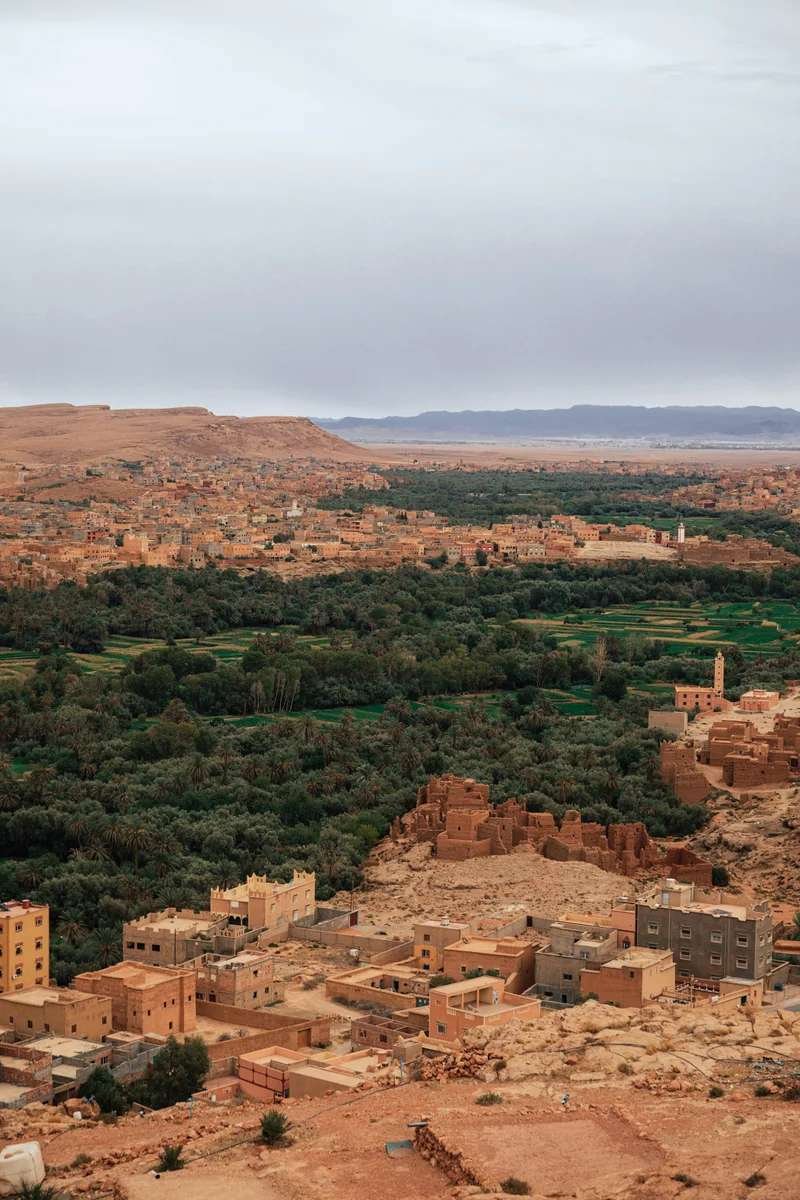
Past Ouarzazate, you drive through the Dadès and Todra valleys. These aren't desert yet. They're river valleys with palm groves and Amazigh (Berber) villages, and the green runs right up to the base of bare rock with nothing in between. The road through Todra Gorge runs between canyon walls that rise 300 meters on either side.
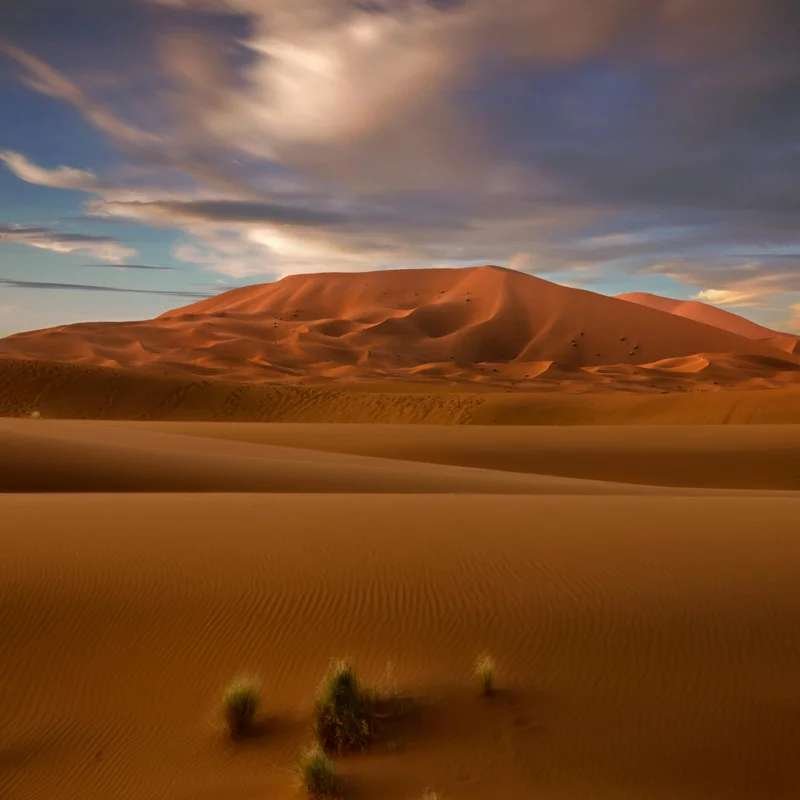
Only in the last hour does the landscape become actual desert. The vegetation disappears, the earth turns sandy, and then Erg Chebbi is simply there on the horizon, orange against flat ground.
The drive matters because it puts the desert somewhere. By the time you reach Erg Chebbi you have watched the country thin out for a whole day, from irrigated valley to stone to sand, and the dunes look different for it.
Merzouga or M'Hamid
Most Sahara trips go to one of two places. Merzouga sits at the edge of Erg Chebbi, the more accessible dune field. M'Hamid is further south, near Erg Chigaga, and takes longer to reach. Which one you pick shapes everything else about the desert leg.
Merzouga is the developed option. The village has hotels, restaurants and a road that takes you to the edge of the sand. Camps run from basic to properly luxurious. The camel trek into the dunes takes 45 minutes to an hour; a 4x4 covers the same ground in a fraction of that. The dunes here are tall and sharply ridged, and although there are crowds, they spread out across a lot of camps.
M'Hamid is the quieter one. The village is small, and reaching the dunes means a longer 4x4 drive over changing ground. Camps are more rustic and the luxury options are fewer. What you get in exchange is space: fewer people come this far south, and the desert reads as wider and emptier.
Camp Selection
Arrival at the Desert Edge
You reach Merzouga or M'Hamid in late afternoon. The camp operators meet you. Then comes the moment that stresses many travelers: the camel ride or 4x4 decision.
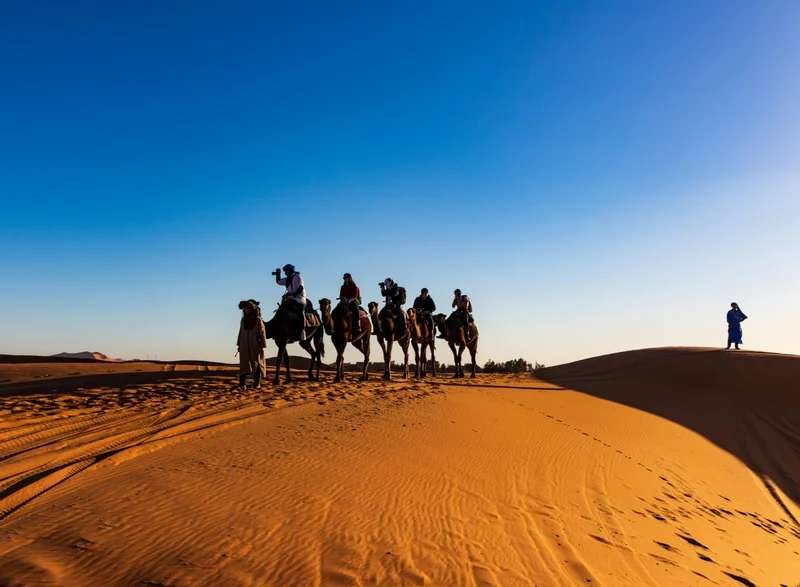
A camel is how everyone pictures arriving, so most travelers try it. The mounting and dismounting is awkward, the swaying gait takes some getting used to, and the animals smell. Forty-five minutes on one is not terrible, but nobody would call it relaxing; people do it for the experience and the photographs. If you have back problems or limited mobility, a camel will hurt you.
The 4x4 option exists at most camps now. You drive straight to the camp. This is practical, comfortable, and completely reasonable. Some travelers feel like they're cheating by skipping camels. This is silly.
A compromise many camps offer: 4x4 to camp, short camel ride for sunset. You get the photo opportunity without extended discomfort.
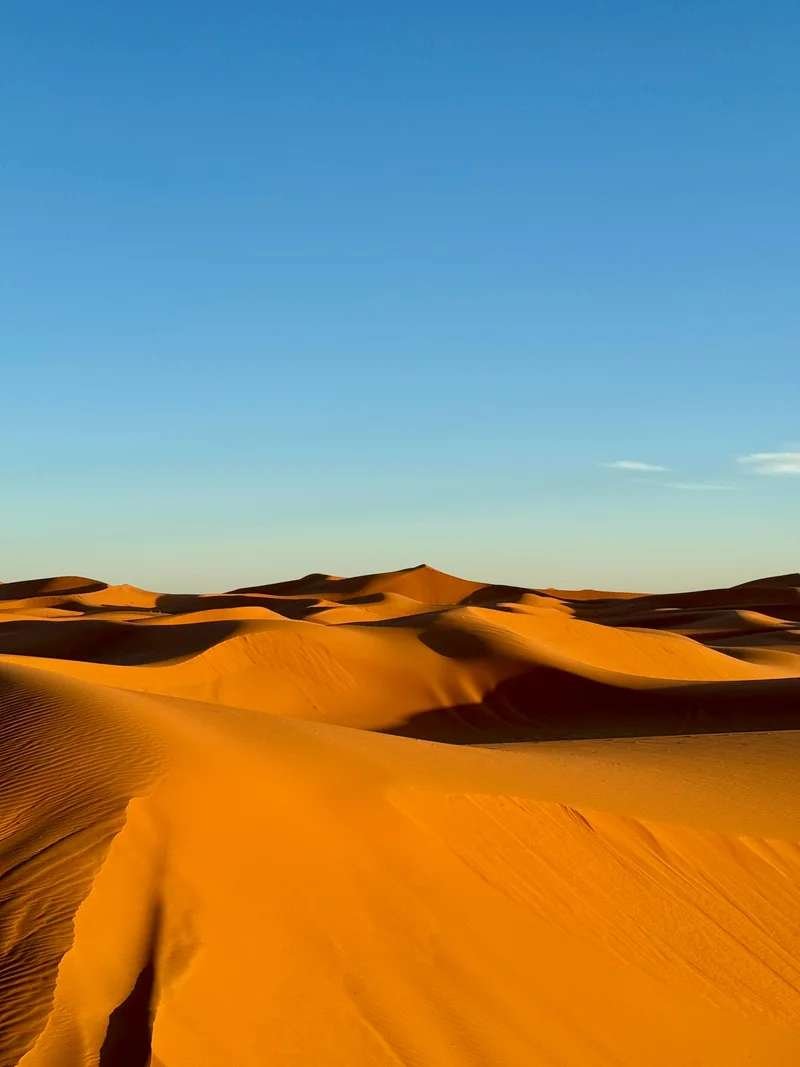
Whichever way you go in, the hour before sunset is the one that lands. The sand runs from yellow to orange to deep amber, shadows stack up behind each ridge, and the heat comes off. On a camel you hear nothing but footfalls in sand. In the 4x4 you watch the light move across the ripples through the window.
The Four Levels of Desert Camp
The phrase "luxury desert camp" covers a very wide range in Morocco. Luxury out here operates on a different scale from luxury in a city, and it is worth knowing where the ceiling sits before you book.
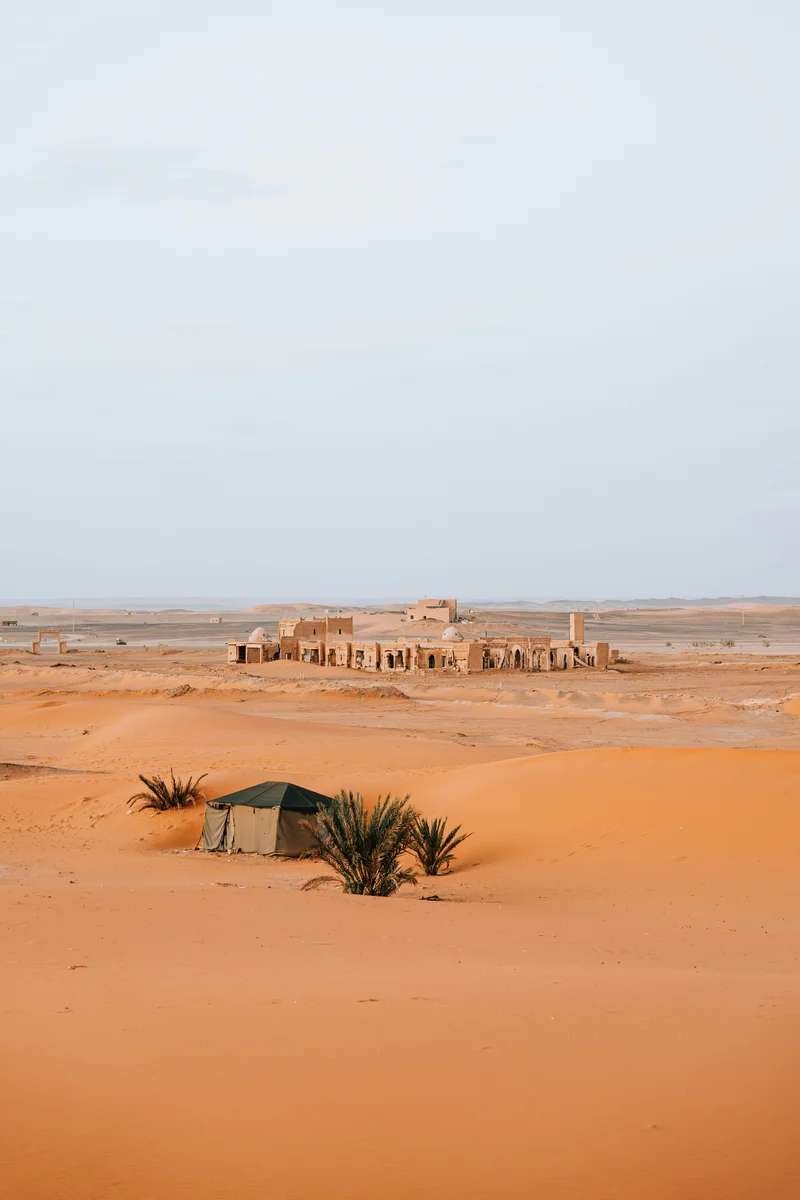
Basic camps offer Amazigh-style tents with simple mattresses on the ground or on low platforms, shared bathrooms outside the sleeping tents, meals cooked over a fire, and no electricity. In winter that means sleeping in your clothes. Travelers who booked this level deliberately tend to enjoy it; travelers who booked it to save money rarely do.
Standard camps upgrade to proper beds, private tents with attached bathrooms, running water heated by solar, and enough electricity to charge a phone. Meals are cooked on site and served at a table. This is the level most travelers find sufficient.
Luxury camps are a real step up. Proper beds with real mattresses. Private bathrooms with flush toilets and hot showers. Interior lighting, seating areas inside the tents, and better food from trained cooks. Some camps have pools, filled with trucked-in water, which sounds absurd until you have spent an afternoon out there.
Ultra-luxury camps approach hotel standards. King beds. Ensuite bathrooms with decent water pressure. Generator-powered air conditioning. WiFi. Restaurant-quality meals. They exist, and they cost a great deal more, because what you are paying for is the logistics of putting hotel infrastructure out in the sand and keeping it running.
What the Desert Limits
Which level you choose comes down to budget and to how much discomfort you are prepared to absorb. Basic works if you are young and adventurous, standard suits most people, and luxury is the sensible choice for honeymoons or for anyone who needs comfort to be reliable. Ultra-luxury is for travelers willing to pay a premium to make a difficult environment feel easy.
An Evening at Camp
You arrive at camp as the sun sets, and the temperature falls fast. What was hot two hours earlier is pleasant within 30 minutes and cool within the hour.
Most camps run the same evening. You settle into your tent and mint tea appears almost immediately; the pouring is ceremonial in Morocco, and the camps use it as the welcome. You drink it watching the last light go.
Dinner is after dark, usually around 8 or 9pm, at communal tables. It is tagine-based as a rule, with salads, bread and fruit alongside. Quality tracks the camp level and is generally adequate. The setting does the rest.
After dinner there is usually music. Amazigh drumming and singing around the fire is the standard, and the rhythms are hypnotic once they settle. Some camps push guests to join in harder than they should; if you would rather sit and listen, say so early and it will be respected.
Then come the stars. There is no light pollution out here and nothing tall on the horizon, so you get the whole sky. If you have only ever seen stars from a city, the first look is disorienting. The Milky Way reads as a distinct band, shooting stars are frequent, and the sheer number of them is the part people struggle to describe afterwards. For many travelers this alone justifies the trip.
Stargazing Tip
How well you sleep depends on the season and the camp. Winter nights are cold enough that you will want every blanket they hand you; summer nights stay warm; spring and fall need a jacket and nothing more. If you are far enough from the other camps the silence is absolute, and it takes a night to stop finding that strange. Sunrise comes later out here than people expect: in December and January the sun is not over the ridge until after seven, and in late May it is up shortly after five. Ask the camp what time to be out, and allow longer than you think for the climb in soft sand.
Sunrise, Sandboards and Sitting Still
The desert is mostly a place you sit in. A handful of activities recur at almost every camp.
The sunrise dune climb is near-universal. You wake before dawn, climb a high dune and watch the light come up; the color changes minute by minute, and climbing in soft sand is harder than it looks. Allow an hour for the climb, the sitting and the way down.
Sandboarding works on the steeper dunes. Camps provide boards. You climb up, slide down. It's fun for about 20 minutes. Then the climbing catches up with you. Children last longer at it than adults.
Walking in the dunes shows you what you miss from camp or from the back of a camel. Plants turn up where nothing should grow. Animal tracks cross the ridges overnight and are gone by mid-morning. The wind leaves a fine ripple pattern in the sand, and you can feel warm air lifting off the slopes. Twenty minutes out, the camp is behind a ridge and out of earshot.
Some camps arrange 4x4 excursions to nomad families. These run from genuine encounter to staged performance depending on who is selling them. The good ones take you to families still living that way, and you see how water is carried, how the animals are moved, how the day is organized around heat. The bad ones feel like visiting a human zoo. Ask the operator who arranged the visit and what the family receives from it. If the answer is vague, decline.
Simply sitting in camp and watching the light move across the dunes is underrated. Nothing about the place holds still: the wind is always working the sand, and the angle of the sun keeps changing the color.
Temperatures, Season by Season
The desert is not uniformly hot. The gap between the afternoon and the small hours is the thing travelers are least prepared for, and it is the reason the packing list looks contradictory.
Seasonal Temperature Guide
Spring (March-May): Pleasant days (25-30°C / 77-86°F) and cool nights (10-15°C / 50-59°F). This is good desert weather. You're comfortable during activities. Nights require a jacket but aren't freezing. Spring can be windy, which kicks up sand. This is annoying but not trip-ruining.
Fall (September-November): Mirrors spring and is the more settled of the two: warm days, cool nights, and stable weather. With winter, this is peak desert season.
Winter (December-February): Days are lovely (18-22°C / 64-72°F). Nights drop to around freezing (0-5°C / 32-41°F), so you need real warmth. It is a dry cold, which registers as less bitter than the same figure would in a humid climate, but you will still use every blanket the camp provides. Winter gives the clearest skies and the best stargazing.
Pack layers regardless of season.
The Unglamorous Details
Sand gets in everything. Your shoes, bag, phone, hair, teeth. There is no preventing it. Bring wet wipes and give up on being properly clean for 24 hours.
Bathrooms vary by camp, and even at the top end the water pressure is never hotel-quality. Flush toilets work, though they sometimes need filling from a bucket. Basic camps mean squat toilets or worse. Women should think through how they will manage menstruation in those conditions and bring everything they need with them, on the assumption that the camp will not stock it.
Getting to the bathroom at night is harder than it sounds. The tents sit apart from the facilities and you are crossing soft sand in the dark. Bring a headlamp, or use your phone. The walk is short; it is just not obvious the first time.
Phone service and WiFi run from unreliable to non-existent. A few luxury camps have satellite WiFi, which is slow and expensive. Most have nothing at all. Guests who dreaded that usually stop minding within a couple of hours, but if someone at home needs to be able to reach you, arrange it before you leave the last town with signal.
Packing Essentials
The return leg starts early. You wake for sunrise, eat breakfast, and are usually on the road by 8 or 9am. Driving back in full daylight means you finally see the stretches you passed at dusk on the way in.
What "Luxury" Buys You Out Here
Marketing around luxury desert camps tends to overpromise, so it is worth being specific about what the word covers.
A luxury desert camp offers: comfortable beds, private bathroom with hot shower, reliable heating and cooling, good food, attentive staff, and a designed interior. That is a real achievement given how far all of it has to be carried.
A luxury desert camp does NOT offer: hotel-style amenities, perfectly controlled temperatures, unlimited hot water, instant WiFi, fine dining, or city-level comfort. The environment constrains what's possible regardless of price.
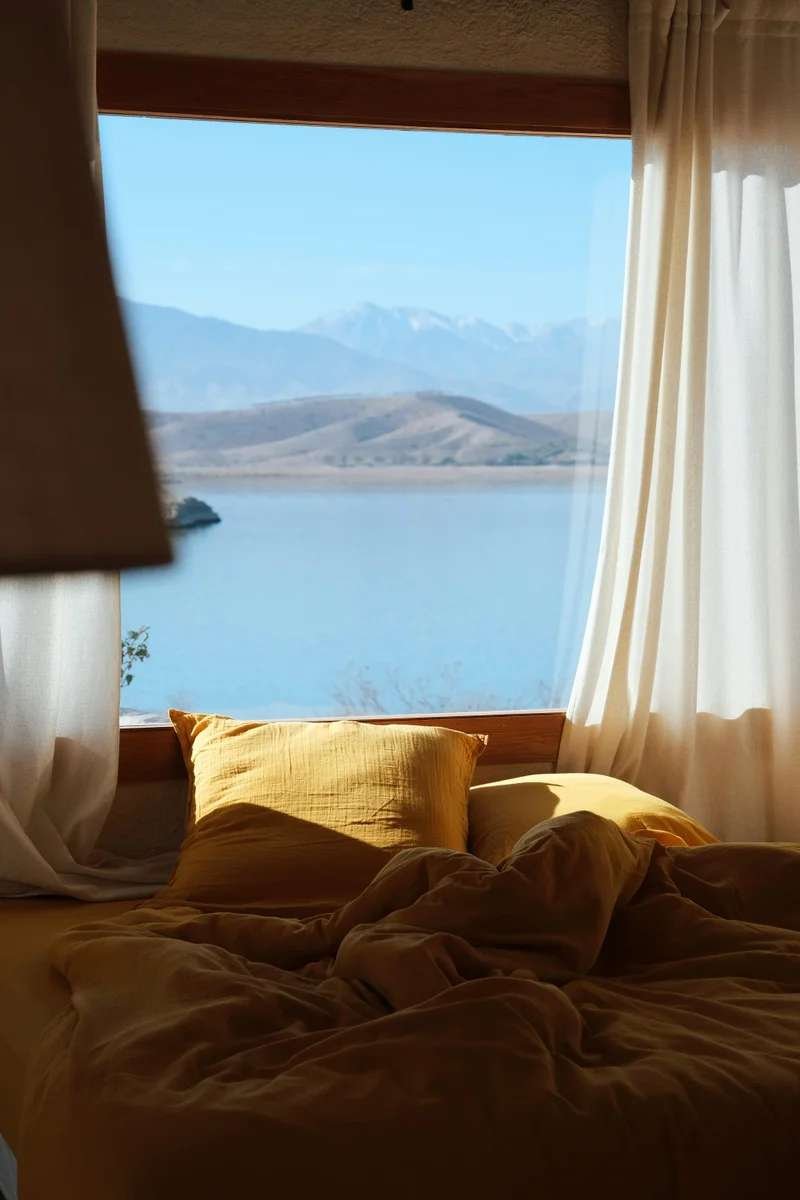
What you are buying is comfort relative to desert conditions rather than comfort in the absolute. The price covers the logistics of getting that comfort a long way from anywhere, and for many travelers it is money well spent. But it's not the Four Seasons in the sand.
Is One Night Enough?
Most Sahara trips include one night in the desert, and one night covers the essentials: the drive out, arrival, sunset, stars, sunrise, and the drive back. You get the desert without a long stretch in basic conditions.
Two nights is the better trip if you have the days. The first night you are too stimulated to settle; by the second you have adjusted, and the quieter part of the place starts to register. It also leaves room for a day trip to somewhere nearby, or for doing nothing at all.
Three nights starts to feel long. Unless you are trekking between camps or running a longer 4x4 expedition, the experience does not deepen much past the second night, and the camp facilities begin to wear.
If you can only take one night, take it. If you can take two, take two. We rarely recommend three.
How This Fits Into Larger Morocco Trips
The Sahara typically anchors the middle of Morocco itineraries. You spend days traveling there from Marrakech or Fes. One or two nights in the desert. Then continue to your next destination.
Common patterns: Marrakech → Sahara → Fes creates a southern Morocco arc. You see Atlas, desert, and two imperial cities. This takes 7-10 days minimum.
Alternative: Marrakech → Sahara → return to Marrakech via a different route. This creates a loop through southern Morocco's varied landscapes. Good for travelers who want desert but don't need both Marrakech and Fes.
The desert leg adds 3-4 days to any itinerary (two days of driving, one or two nights in the desert). That is a substantial share of most trips and usually worth it. After a week of medinas, the scale and the silence do something the cities cannot.
Our guide to timing, including desert visits breaks seasonal planning down region by region.
The Sahara shapes the rest of the trip whichever way you build it: as a cultural journey with the desert in the middle, or as a trip built around the dunes themselves. Whatever you do afterwards will feel busier.
Managing Expectations
The version in most people's heads involves gliding silently across endless dunes on a noble camel. What happens is forty-five bumpy minutes on a smelly one, to a camp a 4x4 reaches in a quarter of the time.
What nobody prepares you for is the sky. You will see stars you have no reference for, sunrise will remake an entire landscape in 20 minutes, and you will open the tent onto dunes.
Planning the Desert Leg
Most desert legs we plan take one of two shapes: a remote camp built around a honeymoon, or a few days of landscape set between cities. Either way, the Sahara sits differently in an itinerary from the mountains or the Atlantic coast. It is the part of the trip with nothing in it.
We match the camp level to how much discomfort you actually want to absorb, and we say so plainly when the level you have chosen will not deliver what you are picturing.
Start planning your Morocco journey →
Quick Sahara Reference
The Sahara is impressive, and it is also hard work. Book it on those terms. And pack the jacket.
Frequently Asked Questions
- What is a camel ride in the Sahara really like?
Bumpier and slower than the photographs suggest. You mount while the animal is kneeling and it stands back legs first, which pitches you forward before you have settled. After that the gait swings you fore and aft the whole way. They smell. The ride out to camp runs about 45 minutes, which is roughly the point at which most people have had enough, and anyone with an unreliable back should skip it. Most camps now offer the sensible compromise: a 4x4 to camp, then a short ride at sunset for the photographs.
- What facilities do Sahara desert camps have?
It depends entirely on the camp level. Basic: mattresses on the ground, shared bathrooms outside the tents, no electricity. Standard: proper beds, a private bathroom with solar-heated water, enough power to charge a phone. Luxury: flush toilets, hot showers, furnished tents and a trained cook. Ultra-luxury adds generator air conditioning and satellite WiFi. At every level the water is finite, the power is finite, and the sand gets in.
- How hot or cold does the Sahara Desert get?
Day and night are two different climates. Summer afternoons reach 45-50 degrees Celsius, which is why the better camps close from June to August. Winter days are pleasant at 18-22 degrees and the nights sit around freezing; spring and fall split the difference, at 25-30 degrees by day and 10-15 after dark.
- Is a Sahara Desert trip worth it?
Yes, for the night sky and for the drive out through the Atlas and the river valleys, which between them are most of what people describe afterwards.
- How long does it take to get to the Sahara from Marrakech?
The drive from Marrakech to Merzouga takes 7 to 9 hours, over the Tizi n Tichka pass and through Ouarzazate and the Dades Valley. Split it across two days with an overnight stop; the road does a great deal of the work on this trip.